
Driving Marketing Team Performance Without Burnout with the FAPI Marketing Framework™
One of the most common questions marketing leaders ask is: What is the ideal size of a marketing team?
The FAPI Marketing Framework™ does not prescribe a single "right" or universal team size for every organization. Instead, the ideal team structure and headcount should be determined by the company's specific marketing objectives and the tactical blueprint established during the Architecture Module.
From a FAPI Marketing Framework perspective, effective marketing management is not about managing more people—it is about creating a structured operating environment that enables teams to perform at their best without becoming overwhelmed. This requires a shift away from reactive, ad hoc management practices toward a systems-based approach that promotes clarity, accountability, and sustainable performance.
1. Avoid the "Lone Expert" Trap
Many marketing teams rely too heavily on a single individual who becomes the default expert for every marketing activity. While this may work in the short term, it creates bottlenecks, limits scalability, and increases the risk of burnout.
Instead, teams should be structured around the user journey, ensuring that responsibilities are distributed across multiple capabilities and touchpoints. This creates resilience, improves collaboration, and reduces dependency on any one individual.
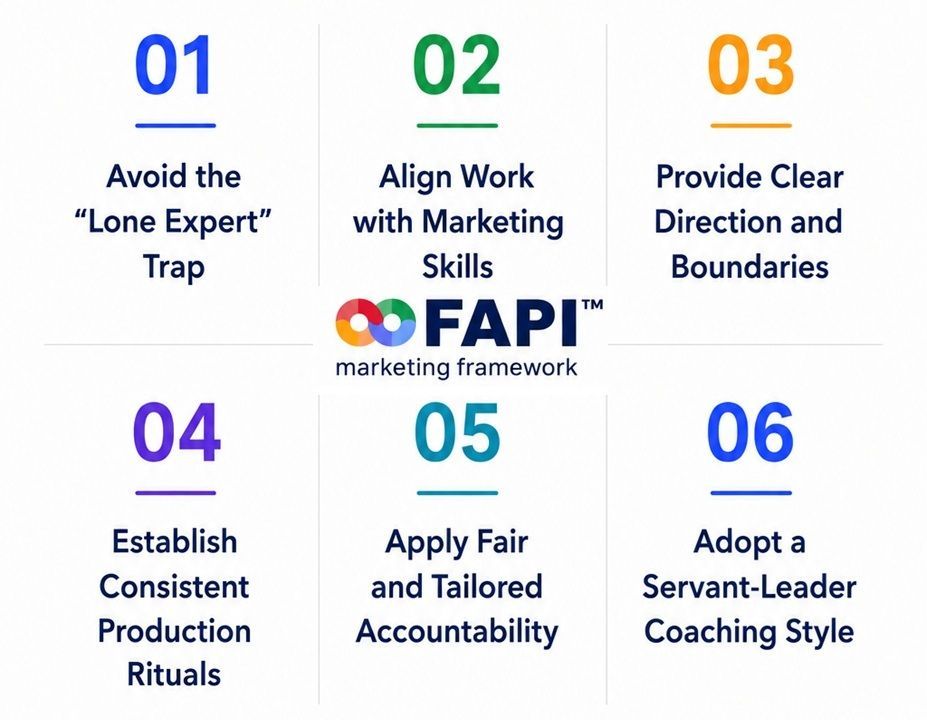
2. Align Work with Marketing Skills and Archetypes
Not every marketer is suited to every task. High-performing teams recognize and leverage individual strengths.
Organizations can use marketing archetypes to help define roles and responsibilities, including:
- The Planner
- The Strategist
- The Seller
- The Creative
- The Analyst
- The Technologist
- The Networker
- The Doer
By aligning responsibilities with natural capabilities and expertise, marketing leaders can improve both productivity and job satisfaction.
3. Provide Crystal-Clear Direction and Boundaries
Ambiguity is one of the leading causes of inefficiency and frustration within marketing teams.
Before execution begins, team members should be equipped with a detailed Marketing Playbook, clearly defined Scopes of Work (SOWs), and documented Standard Operating Procedures (SOPs). These resources ensure that every individual understands exactly what they are responsible for, how work should be performed, and which activities fall outside their scope.
Clear expectations reduce confusion, improve accountability, and allow teams to focus on execution rather than interpretation.
4. Establish Consistent Production Rituals
Successful marketing teams operate on rhythm and cadence rather than constant supervision.
To keep execution synchronized without micromanagement, organizations should implement structured production rituals. These recurring meetings and collaboration checkpoints create alignment, facilitate communication, and ensure that priorities remain visible across the team.
Consistent rituals help transform marketing from a series of disconnected tasks into a coordinated production system.
5. Apply Fair and Tailored Accountability
A major contributor to marketer burnout is being evaluated against business outcomes that fall outside an individual's direct control.
The FAPI Marketing Framework advocates for fair and tailored accountability by aligning performance measurement with each person's role, responsibilities, and sphere of influence. Marketers should be assessed against the activities and outcomes they can realistically impact, rather than being held solely accountable for overarching business results.
This approach creates a more equitable performance culture while encouraging ownership and continuous improvement.
6. Adopt a Servant-Leadership Coaching Style
The role of the modern marketing manager has evolved.
Within the FAPI Marketing Framework, the marketing leader—or Plan Master—acts less like a traditional manager and more like a coach and facilitator. Their responsibility is to remove obstacles, provide guidance, create clarity, and support team members in achieving their objectives.
This servant-leadership approach fosters trust, autonomy, and professional growth while creating an environment where people can consistently perform at a high level.
Balanced Marketing Architecture: Building a Flexible, High-Performance Team
Ultimately, the right marketing team size is not determined by a fixed headcount benchmark. It is achieved when the marketing manager acts as a Chief Marketing Architect, carefully balancing the core internal team with flexible, specialized external resources.
This approach ensures that all required capabilities are available when needed, while avoiding unnecessary overhead and preventing the organization from overextending its budget.
When supported by clear architecture, defined processes, and effective leadership, marketing teams can achieve sustainable high performance without sacrificing employee wellbeing.
Ready to transform your marketing team from a chaotic, bottlenecked operation into a high-performing, scalable production system? Join the FAPI Marketing Framework Academy today!