
The Looming Crisis of Accountability in Marketing: Why AI Demands Smarter Governance
Artificial intelligence is transforming marketing at an unprecedented pace and it is promises significant gains in productivity, operating efficiency, and organizational capacity. Yet beneath these advances lies an emerging governance challenge. As marketing execution becomes increasingly automated, the relationship between human judgement, decision-making authority, and commercial accountability risks becoming progressively weaker.
The central question is no longer simply what AI can do for marketers, but who remains responsible for the decisions, actions, and commercial outcomes that AI increasingly influences.
When marketing teams routinely accept algorithmic recommendations without questioning their rationale, professional judgement gradually gives way to passive system monitoring. Decisions that previously required deliberate human evaluation become embedded in automated workflows, making it increasingly difficult to delineate responsibilities across planning, production, quality control, and ultimate commercial outcomes.
While AI expands an organisation's capacity to act, it can simultaneously erode the human agency necessary to exercise meaningful control over those actions.
Addressing this challenge requires more than technical safeguards, compliance policies, or additional management oversight. It demands a more sophisticated approach to marketing governance, one that establishes clear strategic direction, defines decision-making authority, aligns operational resources, and preserves accountability throughout the marketing function.
The interplay of marketing governance, agency, and accountability
Effective marketing governance begins with recognising that governance, agency, and accountability are distinct yet interdependent organizational principles.
- Governance establishes how the marketing function is directed, controlled, and overseen. It defines the strategic boundaries, operating standards, ethical principles, responsibilities, and decision-making structures within which marketing activities occur.
- Agency provides individuals and teams with the authority, autonomy, resources, and capacity to make decisions and act on behalf of the organisation. It serves as the mechanism through which governance becomes operational, enabling professionals to exercise judgement and take meaningful action within defined boundaries.
- Accountability ensures that those individuals and teams remain answerable for their decisions, actions, and performance. It requires clearly assigned responsibilities, transparent reporting, effective oversight, and robust mechanisms for evaluating outcomes and implementing corrective action.
Together, these principles establish a fundamental chain of organizational responsibility: governance defines the boundaries, agency empowers action within those boundaries, and accountability ensures that decisions and actions remain subject to scrutiny.
This distinction becomes particularly vital as AI systems assume an expanding role in marketing execution. Although algorithms may generate recommendations, allocate resources, optimise campaigns, or produce creative assets, they do not assume organizational accountability for the commercial consequences of those activities. That responsibility remains firmly with the individuals and leadership structures that authorize, oversee, and deploy them.
The challenge for modern marketing leaders, therefore, is not to retain direct human involvement in every operational decision, but to establish precisely where authority resides, which decisions can be delegated, what boundaries govern that delegation, and who remains accountable for the results.
Decisional leadership: Bridging computational capability and commercial judgement
Machine learning systems excel at identifying patterns, analysing large datasets, predicting outcomes, and optimising performance against predefined objectives. However, the ability to process information at scale does not translate into an understanding of organizational purpose, competitive positioning, customer relationships, or long-term commercial value.
An algorithm may identify a campaign configuration that generates more conversions at a lower cost, yet remain completely blind to the implications for brand positioning, customer experience, long-term profitability, or future demand. Similarly, predictive models may identify statistically significant correlations without establishing the causal mechanisms necessary to justify strategic decisions.
These limitations are not arguments against AI; rather, they demonstrate why AI-driven marketing requires stronger, rather than weaker, decisional leadership.
As automated systems become more capable of determining
how marketing activities are executed, human leaders must become more deliberate in defining
why those activities matter,
what constitutes true success, and
which trade-offs are commercially acceptable.
This is where the
FAPI Marketing Framework™ introduces a critical organizational distinction.
FAPI recognizes four essential domains of marketing management:
Strategic,
Tactical,
Operational, and
Decisional. While these domains are deeply interconnected, the
Decisional domain plays a pivotal role in ensuring that marketing activities are informed by evidence, interpreted within their broader commercial context, and translated into responsible management action.
Building governance into the marketing operating model
If AI-driven accountability in marketing is fundamentally an organizational challenge, the solution must be embedded within the architecture of the marketing function rather than treated as a separate technology management exercise.
| FAPI Module | Governance Focus | Accountability & Scope | Key Deliverables & Controls |
|---|---|---|---|
| Frame | Strategic & Directional | Defines vision, strategic objectives, value proposition, policy alignment and risk appetite. Ensures alignment with business priorities and compliance requirements before resource allocation. | Problem validation, strategic alignment, business case, risk guidelines and compliance mandates. |
| Architecture | Structural & Planning | Establishes operating models, system design, technical standards, resource structures and implementation roadmaps. Ensures scalability, security and structural integrity. | Architecture approvals, operating models, governance policies, structural blueprints and risk mitigation plans. |
| Production | Process & Resources | Governs execution, resource allocation, operational workflows, quality assurance and day-to-day risk. Ensures delivery follows approved standards and plans. | SLAs, resource tracking, QA reports, change logs, incident management and operational risk monitoring. |
| Insights | Performance & Financial | Measures outcomes, financial performance, ROI and strategic effectiveness. Uses evidence and feedback to drive accountability and continuous improvement. | KPI/OKR dashboards, financial audits, cost-benefit analysis, performance reviews and feedback into Frame. |
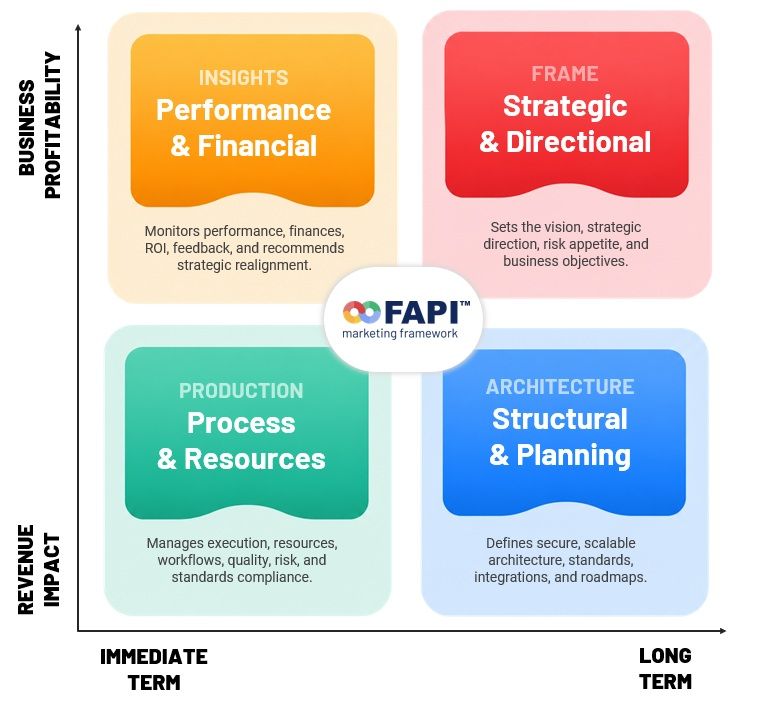
The FAPI Marketing Framework provides this structure by organizing marketing management into four interconnected modules:
Frame,
Architecture,
Production, and
Insights. Each module addresses a distinct area of management responsibility while contributing to a coherent system of governance.
As artificial intelligence continues to reshape the speed and scale of marketing execution, organizations stand at a critical crossroads. The primary risk facing marketing leaders is not the adoption of sophisticated automation, but the silent erosion of accountability that occurs when computational efficiency is mistaken for commercial judgement. Algorithms can process vast streams of data and optimize tactical output, but they cannot replace the strategic marketing vision, ethical orientation, and ultimate responsibility that define human decisional leadership.
Navigating this paradigm shift demands a deliberate operating model. By embedding governance into the core architecture of the marketing function through the FAPI Marketing Framework™, across Frame, Architecture, Production, and Insights, businesses can maintain clear decision-making boundaries and robust accountability. Ultimately, AI should amplify human capability rather than replace professional oversight; ensuring that as marketing technologies become smarter, organizational governance becomes equally intelligent, resilient, and decisive.
Learn more about the FAPI Marketing Framework at
www.chasefive.com