
The Marketing Productivity Paradox and Evolving Cost Pressures. A Guide for the C-Suite
AI capabilities have already had a significant impact on marketing, and that impact will continue to accelerate. The prevailing view among business leaders is that AI is likely to help reduce the cost of marketing, an expectation shared by many marketing practitioners. But this assumption deserves closer examination.
Understanding how AI may ultimately affect marketing expenditure requires a more holistic view of the underlying economics of marketing execution. Predicting whether AI will drive an increase or decrease in marketing expenditure should begin with an analysis of how marketing cost dynamics are structured.
The fundamental cost structure of marketing execution
The overall cost of marketing execution is determined by two primary drivers:
P) Cost of Production: The cost of producing the artifacts that construct and communicate a marketing message.
M) Cost of Media: The cost of carrying that marketing message to its intended audience.
The total cost of production (P) can be divided into two broad categories: labor costs (skills and human resources) and tool costs (technology and materials).
The cost of media, or visibility (M), encompasses media in all its various forms, online and offline, from advertising, sponsorship, endorsements, pay-to-publish and any other forms of amplification. For the purposes of this analysis, we can include “organic” (or earned) media in the cost of media. While organic media is not paid in the usual sense, its availability and reach is impacted by the direct or indirect provisioning of paid media, as discussed in the article on the scarcity and volatility of organic media.
The impact of decreasing marketing production costs and its compounding effects
The cost of a unit of marketing production has been gradually but consistently declining for some time, driven predominantly by three trends.
First, the widespread offshoring of certain marketing production services to lower-cost economies is reducing labor costs. Second, the introduction of software applications has reduced marketing’s reliance on expensive, IT-heavy production. Third, the significant expansion of training and development opportunities for people entering the marketing production workforce has created a healthy skills supply and, therefore, competition among qualified marketing production specialists across a wide range of disciplines.
However, hard evidence shows that greater production efficiency over a prolonged period has not automatically translated into lower overall marketing expenditure for businesses. This exposes a fundamental misconception in marketing economics: reducing the unit cost of production does not necessarily reduce the total cost of marketing but instead increases production complexity.
An example of this dynamic is the rising cost of the martech stack, the technologies and tools used to support marketing production and execution.
Martech was originally positioned as a cost-containment strategy, enabling organizations to replace expensive, bespoke IT systems with more flexible and economical SaaS solutions.
In the immediate term, martech tools increased the productivity of marketing teams and helped reduce the unit cost of production. Over time, however, this contributed to increased competitiveness and the need for complex architecture solutions. As a result the economics of martech shifted and marketing software tools now account for an estimated 25–30% of marketing budgets, compared with less than 10% less than fifteen years ago. The number of available solutions grew from roughly 150 in the early 2010s to more than 12,000 by 2025, pushing marketing teams to adopt increasingly complex technology stacks and forcing organizations to reassess how martech is evaluated and implemented.
The AI cost causal loop: Marketing efficiency rate-limiter and primary upward cost drivers
At its most fundamental level, increasing marketing productivity means increasing the rate at which organizations can produce marketing artifacts. That sounds inherently beneficial. However, the ability of those artifacts to achieve cut-through is constrained by a hard rate limiter: the finite availability of media inventory and audience attention.
An organization’s marketing production efficiency may increase dramatically, but its receiver capacity has a hard ceiling that it cannot change or bypass. This ceiling is determined by the availability and accessibility of media inventory and ultimately by the audience’s available share of attention and interest.
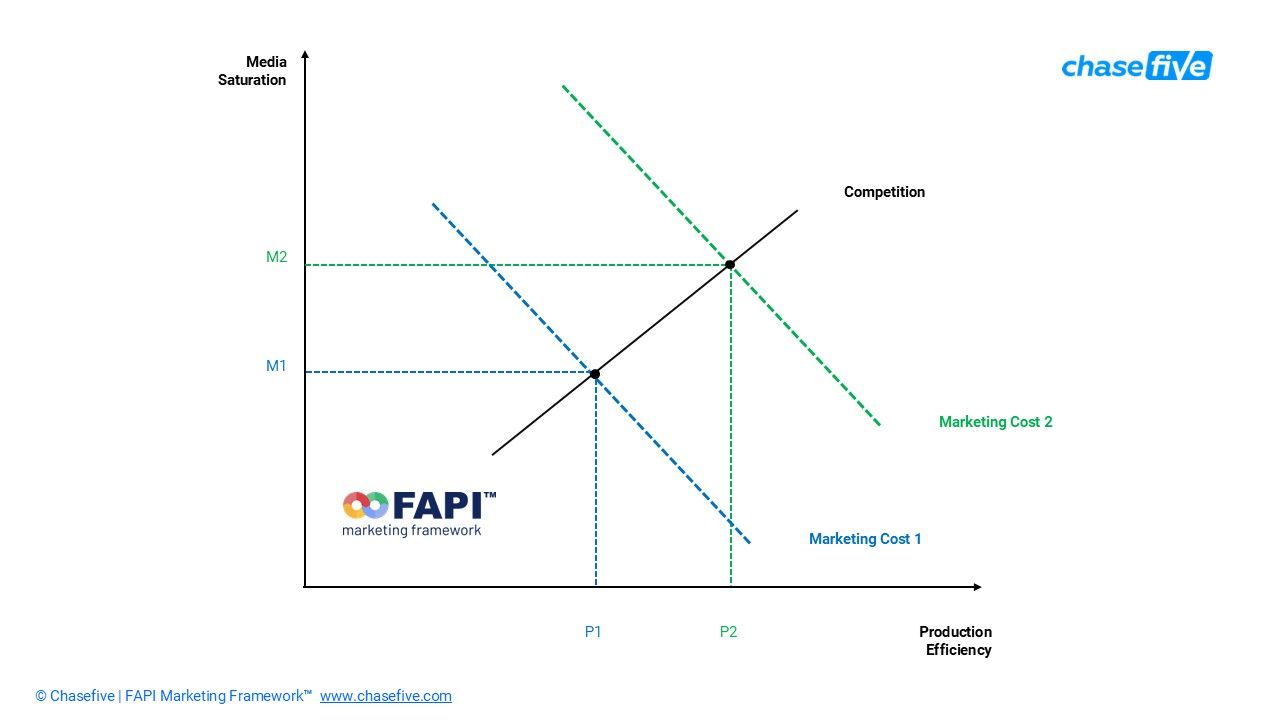
A steep increase in marketing production output is likely to determine a saturation of media inventory and relative price increase, and at the same time a decline in the addressable audience's rate of response. Because in today's performance-driven media buying ecosystem, the price of media exposure is ultimately determined by the propensity of an addressable audience to respond to or engage with a message, as the share of interest declines, the effective availability of media inventory also declines.
As effective media reach becomes more expensive—either because unit costs increase or because a higher frequency of exposure is required to generate the desired level of response—organizations will need greater reach, higher frequency, broader distribution or more sophisticated targeting to achieve the same level of impact. This creates a reinforcing causal loop.
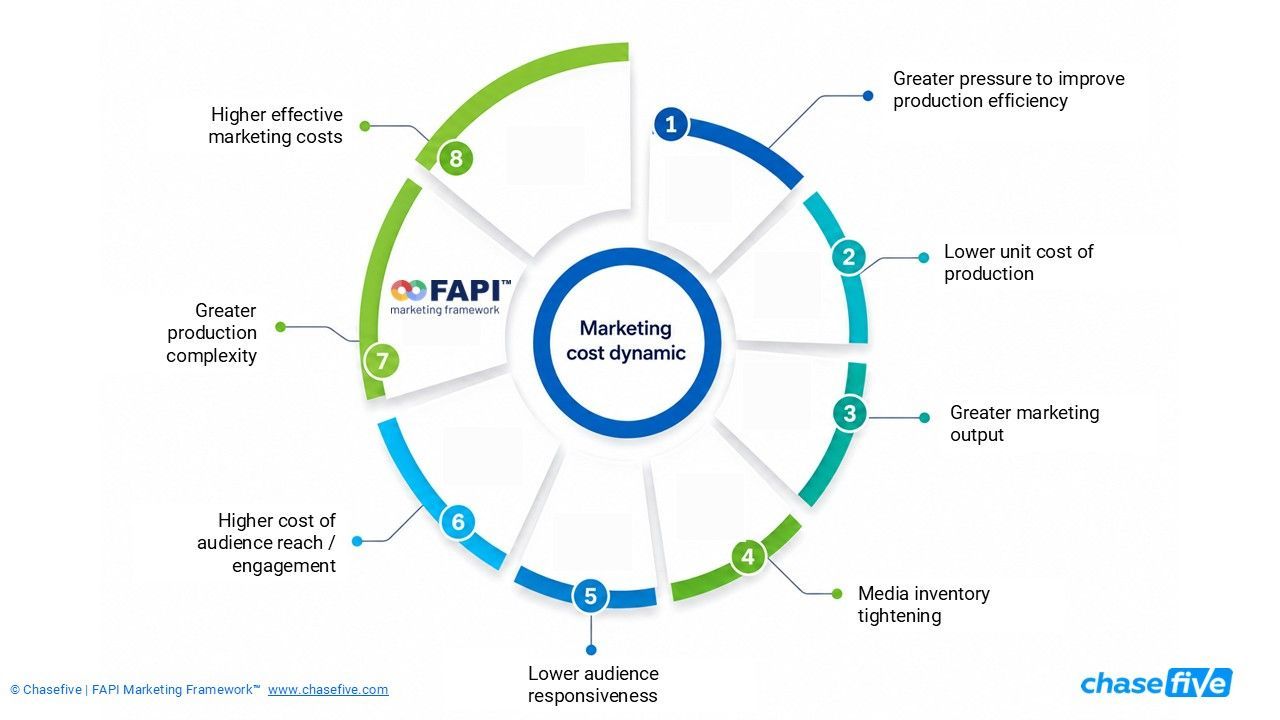
The marginal cost of effective marketing can therefore rise even as the unit cost of marketing production falls.
If production costs decline while marketing output increases, an organization could theoretically reinvest the savings generated by production efficiencies into media buying thus offsetting the increased cost of media. However, this strategy will not work if all organizations pursue the same approach.
In essence, greater productivity increases media saturation through a double pressure:
- more marketing output competing for attention; and
- lower audience responsiveness as exposure and saturation increase.
The result is a more competitive marketing environment in which businesses require greater media investment, greater creative differentiation, and greater operational sophistication to achieve the same level of impact.
This is the marketing productivity paradox: making marketing cheaper to produce does not necessarily make marketing cheaper. Indeed, under certain conditions, it can have the opposite effect.
A paradigm shift for the marketing production supply chain and the role of the C-Suite
The marketing services supply chain has become increasingly effective at developing technologies and solutions to improve production efficiency. As a result, today's small and mid-sized organizations have significantly increased their marketing output across campaigns, content formats, channels, data and technology. At the same time, growing competition has increased marketing complexity, contributing to higher overall marketing expenditure.
AI is likely to further reduce the marginal cost and time required to produce many marketing artifacts, enabling content, imagery, video, analysis, personalization, campaign variants, and other outputs to be created faster and at a lower unit cost. AI can therefore accelerate the existing cost-increasing causal loop, exacerbating competition for audience attention and increasing demand for more sophisticated production and media capabilities.
It is a strategic responsibility of the C-suite to define a marketing direction that breaks this cost-increase loop. Rather than asking only how AI can reduce the cost of marketing production, business leaders should also ask how AI can improve marketing effectiveness without generating unnecessary output, complexity or competition for attention.
The C-suite should reconsider whether AI investment is being evaluated not just against productivity but also: attention → economic return measured in marketing spend coefficient.
The required paradigm shift is not simply towards more efficient marketing production, but towards clearer direction and the rationalization of marketing resources.
The marketing organizations that will win the AI productivity race are those that can re-center marketing on its core economic function: building closer relationships with the right audiences and creating valuable experiences for those audiences within a predictable and scalable operational structure.
Learn more about the impact of AI on marketing management and how to organize marketing as a systematic and strategic process in the FAPI Marketing Framework Academy.