
AI ushers in the era of Relationship Attribution Model, a coherent approach to marketing attribution modeling
Traditional funnel metrics that rely on individual touchpoint attribution, such as single-touch, first-click, or last-click models, can be limited because they assign the full value of a conversion to one interaction. This view of the user journey oversimplifies the way people actually make decisions.
As AI-powered search, large language models (LLMs), and increasingly fragmented customer journeys reshape how people buy, traditional attribution models are becoming even less effective at explaining marketing performance.
A correlational approach, defined as a
Relationship Attribution Model within the
FAPI Marketing Framework, provides business decision-makers with a clearer view of user behaviour in relation to marketing activity deployment for several reasons:
Comprehensive, holistic measurement
Rather than decomposing marketing into isolated events, correlational attribution evaluates how marketing activities relate to one another and assigns value to touchpoints based on their correlation with conversions over time, not on a fixed single-touch rule.
Recognition of marketing synergy (the halo effect)
Channels influence each other. Heavy investment in display advertising can raise overall brand awareness and subsequently boost organic search traffic. Correlational models capture these synergistic interactions across the media mix.
Resilience in a privacy-first, cookieless world
As privacy regulations tighten and third-party cookies are phased out, click-based tracking and traditional multi-touch attribution become less reliable. Correlational analysis helps marketers navigate fragmented data by identifying systemic patterns across the user journey instead of relying on individual cookie-based traces.
Emphasis on relationship-building
Consider inviting a long-time friend to a dinner party. Their acceptance reflects a long standing relationship, not solely the most recent touchpoint. Correlational metrics shift focus from isolated transactions to how users respond throughout the relationship-building process.
What is Relationship Attribution Model within the FAPI Marketing Framework
Within the FAPI Marketing Framework, the
Relationship Attribution Model is a coherent approach to attribution modelling that assigns value to different marketing touchpoints based on their relationships and correlations with conversions over time.
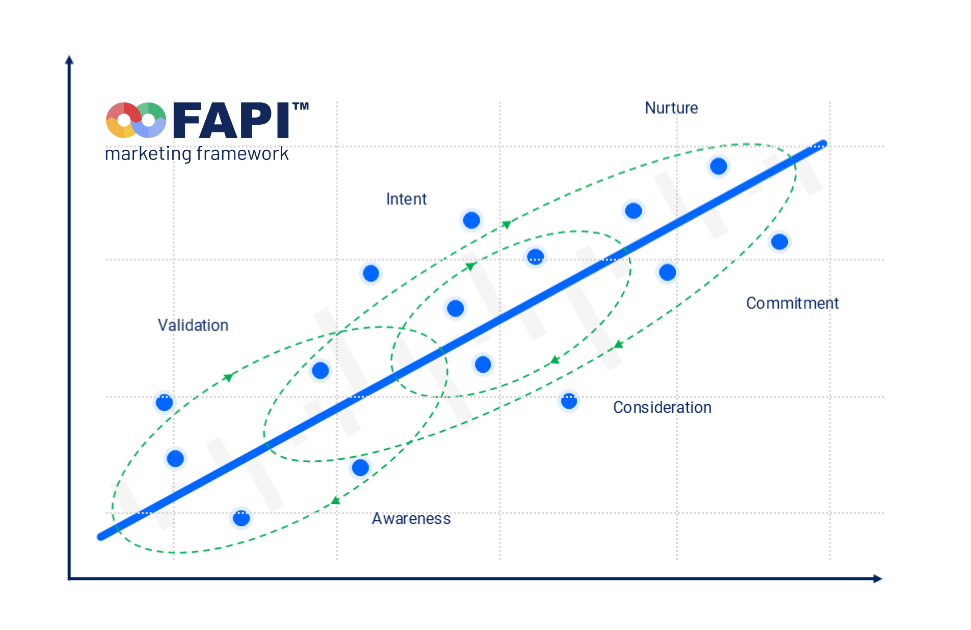
Unlike traditional, fixed attribution models such as single-touchpoint, first-click, or last-click attribution, which assign the entire value of a conversion to just one isolated interaction, the Relationship Attribution Model provides a holistic view of the user journey based on two key aspects, correlational analysis and recursive weighting
- Correlation analysis: It employs sophisticated analytical methods, such as correlation analysis, to evaluate exactly how different marketing interactions contribute collectively to a desired action, such as a sales conversion.
- Recursive weighting: Rather than using a rigid formula, the FAPI Relationship Attribution Model model gives the marketing manager the flexibility to determine the specific weighting and value of each touchpoint within the overall conversion process.
Ultimately, the Relationship Attribution Model helps businesses avoid a distorted understanding of user behavior by evaluating the interrelation of all marketing efforts rather than breaking them down into isolated, single-touch events thus making better marketing resources allocation decisions.
Why AI LLMs search means Relationship Attribution Model is key
The buying decision process is ultimately the manifestation of a complex system and therefore it is not linear. Buyer behavior has become more complex and fragmented than ever before across media and devices.
In a nonlinear system, if Action A produces effect 1 and Action B produces effect 2, then when actions A and B occur simultaneously the resulting effect is neither 1 nor 2, nor the sum of 1 and 2; rather, it is a value that contains elements of both 1 and 2.
Traditional single-touch attribution models are unreliable at any meaningful scale as they assume an isolated, linear path and fail to account for the synergistic impact of all touchpoints. In essence they represent a scenario where Action A and B occur simultaneously, but only effect 1 is taken into account.
In real-world customer behavior, the path from discovery to purchase is rarely direct. A modern customer's journey typically spans an extended period and includes numerous interactions, for example, McKinsey Insights reports that the average hotel-booking journey involves at least 45 distinct touchpoints across search and AI, social media, aggregator sites, and out-of-home advertising. Because customers move between devices and platforms and marketing messages interact with one another, the journey is fundamentally non‑linear.
Like all complex systems, customer behavior contains a real-life element of unpredictability; many interconnected parts interact nonlinearly, so small changes can lead to large, hard-to-predict outcomes. This does not mean outcomes are completely random; rather, it is possible to describe patterns and correlations to estimate and influence future outcomes when variables are measured consistently within a relatively stable range.
Mastering the FAPI Marketing Framework Relationship Attribution Model enables marketing teams to measure and forecast ROMI more accurately and make data-driven decisions that reflect the real-world complexity of customer behavior.
Learn more and access free FAPI Marketing Framework resources.