
Why the C-Suite Needs to Own Marketing Performance in the Age of AI, and the Risks of Non-Involvement
Strategically, AI has three main effects on marketing: it increases marketing output productivity; it intensifies departmental leverage as marketing continues to absorb key operational processes; and it intensifies competition by saturating delivery value.
Without a strong strategy, governance, or alignment, increased output and leverage simply amplify bad practices at scale and it is why business leaders must take direct ownership of marketing performance.
Too many executives treat marketing as an isolated departmental responsibility rather than a core, cross-functional business capability. This lack of involvement creates a disconnect between business strategy and execution, resulting in fragmented initiatives, inconsistent priorities, and underperforming investments.
To prevent AI from merely accelerating bad marketing, the C-suite and senior leadership team must lead marketing strategically.
Because marketing initiatives have a ripple effect across all functional areas of a business, the senior leadership team must drive the marketing function through six key responsibilities based on the core principles of the FAPI MArketing Framework™.
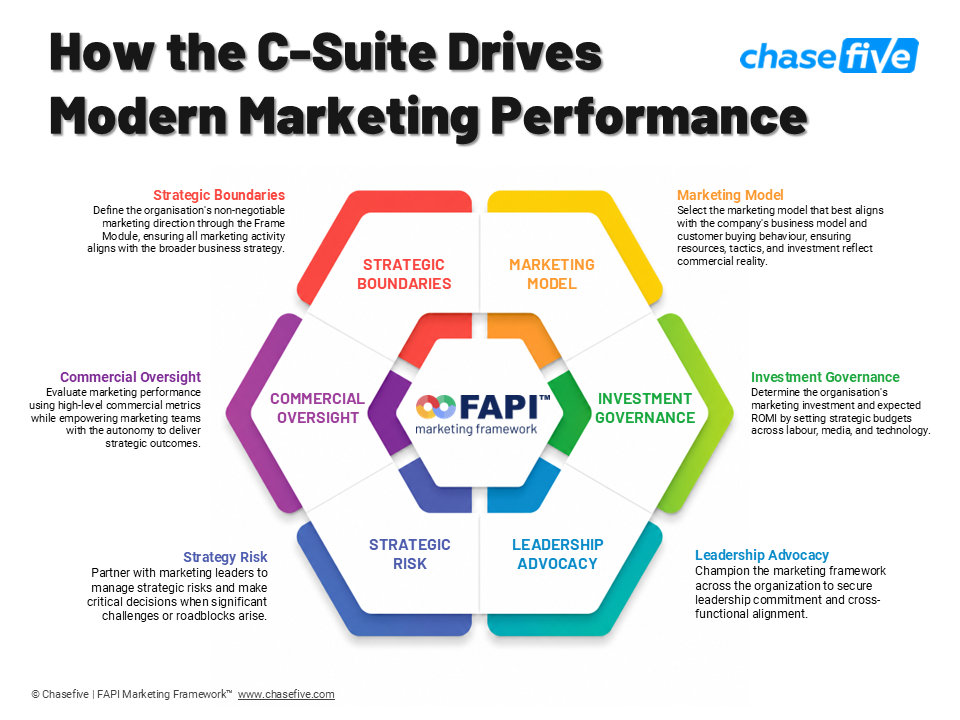
The 6 Strategic Marketing Responsibilities of the C-Suite
1) Formulate Marketing Strategic Boundaries (The Marketing Frame)
The C-suite is responsible for defining the strategic boundaries that guide all marketing activity.
As part of the broader business strategy, the Frame Module within the FAPI Marketing Framework establishes the organisation's non-negotiable strategic direction by defining core components such as positioning, big story messaging, and critical milestone priorities. It also serves as a strategic audit, ensuring leadership has aligned on all critical decisions before execution begins. The outcome is a Strategy Brief that captures the business vision and provides a single source of truth, enabling marketing teams to translate strategy into tactical plans while remaining aligned with the organisation's commercial objectives.
2) Define the Marketing Model
The marketing model determines the tactical approach that best aligns marketing with the company's business model—how it operates and how customers buy.
Rather than applying a one-size-fits-all methodology, the model is selected by evaluating factors such as ownership of the customer database and transaction velocity to determine the most appropriate marketing model (product marketing, database marketing, account-based marketing (ABM), or stakeholder marketing). This ensures that marketing resources, tactics, and investment are aligned with the business's commercial reality and the way value is created for customers.
3) Provide Commercial Oversight
Senior executives must serve as the guiding force for marketing by evaluating performance through commercial outcomes rather than campaign-level metrics.
Leadership should focus on strategic measures such as relationship attribution modelling and the marketing spend coefficient, ensuring marketing contributes to business performance while empowering marketing teams with the execution autonomy needed to achieve those high-level objectives.
4) Define Marketing Investment
The C-suite is responsible for determining the level of marketing investment required to achieve the organisation's commercial objectives, rather than managing day-to-day marketing resources.
As part of the strategic planning process, leadership defines the overall marketing budget across the core marketing cost categories—labour, media, and technology—ensuring investment aligns with business growth targets, market conditions, and the expected return on marketing investment (ROMI). Marketing management is then responsible for deploying those resources effectively.
5) Champion Marketing
The C-suite must actively champion the marketing framework across the organisation to secure executive sponsorship and cross-functional alignment.
By promoting marketing as a strategic business capability rather than a departmental function, leadership ensures that all business units understand, support, and contribute to the organisation's marketing objectives.
6) Manage Strategic Risk
The C-suite must work closely with marketing leadership to identify strategic risks, resolve major roadblocks, and make critical business decisions when required.
By providing governance throughout the execution process, leadership ensures marketing initiatives remain aligned with commercial priorities while adapting to changing business conditions and emerging risks.
Why Business Leaders Should Govern Marketing Performance in the Age of AI
Ultimately, the C-suite’s involvement in marketing performance based on the principles of the FAPI Marketing Framework™ transforms marketing from an isolated, tactical cost center into a powerful engine for strategic growth.
By setting clear boundaries, aligning marketing objectives with overarching business goals, and focusing strictly on high-level commercial outcomes, senior leadership effectively bridges the gap between vision and execution. When executives actively champion and frame the marketing strategy, they eliminate cross-functional silos and cultivate an environment of accountability—ensuring that every marketing dollar spent directly drives top-line revenue and measurable business value.