
Breaking the Marketing Silo: How the FAPI Marketing Framework™ Aligns Sales and Marketing
In many organizations, sales and marketing operate as distinct islands with conflicting priorities. Marketing typically focuses on top-of-funnel brand awareness and lead volume, while sales is laser-focused on bottom-of-funnel conversion and closing deals. When these functions remain decoupled, the results are inevitable: inefficient spend, disjointed messaging, and a fragmented customer experience that ultimately stalls growth.
The FAPI Marketing Framework™ (Frame – Architecture – Production – Insights) fundamentally rejects this isolation. It establishes a structured operational model where sales and marketing collaborate from the first spark of planning through to execution and performance analysis. By embedding sales expertise directly into marketing operations, the framework ensures every marketing dollar spent is a direct investment in revenue generation.
The high cost of the marketing silo
Traditional structures often view marketing as a "support function" rather than a revenue engine. This disconnect creates several systemic friction points:
- Blind Planning: Marketing develops campaigns without visibility into the real-world sales pipeline.
- Lead Friction: Sales teams are handed "qualified" leads that fail to meet actual commercial criteria.
- The Messaging Gap: Prospects experience a jarring shift in tone and value proposition when transitioning from marketing content to sales conversations.
- Vanity Metrics: Reporting focuses on clicks and views rather than tangible revenue impact.
The FAPI framework solves this by weaving collaboration into the very fabric of the marketing operating model.
Collaboration via functional leads
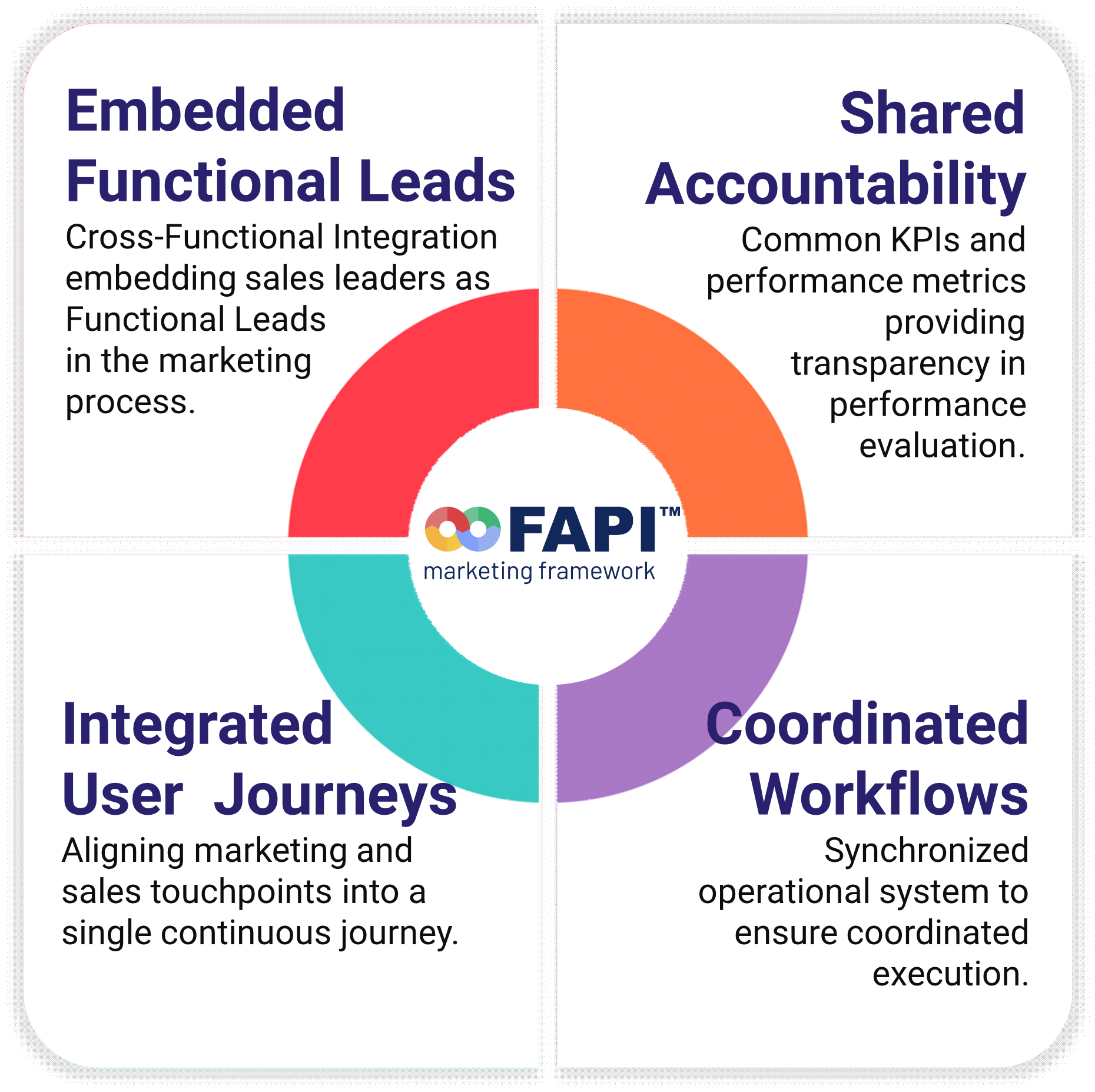
A primary engine of alignment within the framework is the Functional Lead role. Rather than allowing marketing to plan in a vacuum, the FAPI framework mandates that cross-functional stakeholders participate from the outset.
In this model, sales managers are typically appointed as Functional Leads for specific marketing initiatives. Working alongside the Plan Master—the individual orchestrating the process—sales leaders contribute vital commercial intelligence, including:
- Real-world customer objections and evolving buying behaviors.
- Identification of high-priority accounts and target industry trends.
- Validation of campaign strategies against realistic revenue goals.
- Coordination of the internal resources required for seamless follow-up.
Integrating the customer journey
During the Architecture Module, the tactical blueprint of a campaign is designed. Here, the framework requires teams to map a unified user journey that dissolves the border between the "marketing funnel" and the "sales pipeline."
By amalgamating these touchpoints, the transition from automated engagement to human interaction becomes invisible to the customer. The framework ensures both teams agree on:
- Critical engagement milestones.
- The precise moment a prospect should shift from automation to personal outreach.
- The specific content needed to move a prospect through each stage of the lifecycle.
Shared accountability: ending the "Us vs. Them" mentality
The FAPI framework dismantles the traditional blame game—where marketing complains about poor follow-up and sales complains about poor lead quality—by introducing shared accountability.
Through structured "Project Events," both teams meet regularly to review performance and refine tactics in real-time. Crucially, Key Performance Indicators (KPIs) are shifted away from departmental silos and toward shared business objectives:
Shared Success Metrics:
- Marketing’s total contribution to the sales pipeline.
- Lead-to-opportunity conversion velocity.
- Customer Acquisition Cost (CAC) vs. Lifetime Value (LTV).
- Revenue directly attributed to specific campaign architectures.
The need for this synergy is most acute in Account-Based Marketing. In high-value, enterprise-level sales, success depends on surgical coordination. The FAPI framework ensures that sales identifies the "who" (priority accounts and stakeholders) while marketing develops the "what" (highly personalized, tailored content). This synchronized approach ensures that the outreach feels like a single, continuous conversation rather than two different companies talking to the same prospect.
The Plan Master: The architect of alignment
At the heart of this system is the Plan Master. This role is responsible for ensuring that the cross-functional gears are turning in unison. They act as the bridge, coordinating input from sales leaders and operational teams to ensure the final marketing plan is not just creatively bold, but commercially viable.
Marketing as a revenue engine
The FAPI Marketing Framework™ redefines marketing's role within the enterprise. It moves beyond "promotion" to become a structured, operational engine designed to drive revenue in lockstep with sales.
When organizations stop treating sales and marketing as separate functions and start treating them as a unified system, the result is more than just better teamwork—it is a more predictable, scalable path to revenue growth.