
Global Marketing Cost Index. How Geography Shapes the Cost of Marketing Operations

Chasefive Management

Marketing success is often attributed to strategy, creativity, and execution. However, one factor that receives far less attention is the economic environment in which marketing teams operate.


The cost of running marketing activities can vary significantly depending on geography. Talent costs, advertising prices, agency services, and marketing technology pricing all contribute to the true cost structure of marketing operations.


To better understand these differences, we analyzed four key cost drivers across six developed markets:


  • Marketing Management salaries
  • Average Cost of Media (CPM)
  • Agency hourly rates
  • Marketing Technology (MarTech) costs

Together, these factors shape the overall cost of planning, executing, and scaling marketing activities.


The result is the Global Marketing Cost Index, which compares marketing operating costs across the United States, Germany, the United Kingdom, Canada, Australia, and New Zealand.
Chasefive Marketing Cost Index

Overall Marketing Cost Index


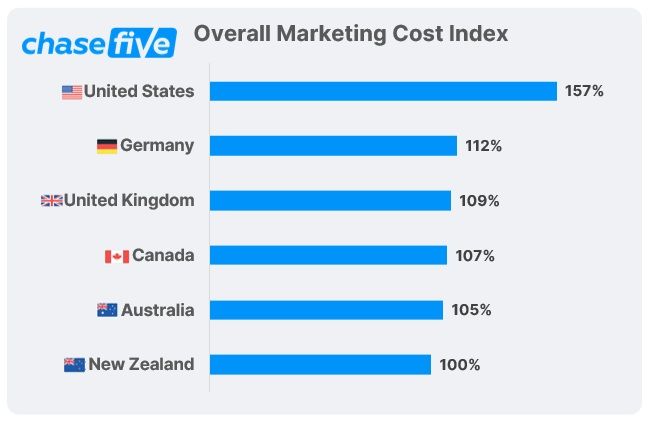
The Global Marketing Cost Index aggregates the primary operational cost drivers of marketing—management salaries, media CPM, and agency hourly rates—using New Zealand as the baseline index of 100.


The analysis reveals a clear hierarchy of marketing cost environments.


The United States ranks significantly higher than all other markets, with an index of 157. This means that running marketing operations in the U.S. can be approximately 57% more expensive than in New Zealand.


Outside the United States, the remaining countries form a relatively narrow cost band:


  • Germany: 112
  • United Kingdom: 109
  • Canada: 107
  • Australia: 105
  • New Zealand: 100


This clustering suggests that while marketing costs vary moderately across developed economies, the U.S. represents a distinct premium marketing environment.


Several factors contribute to this gap, including higher executive compensation levels, intense competition for media inventory, and strong demand for specialized marketing talent.

Chasefive Marketing Cost Index

Marketing Labor Cost


One of the most significant drivers of marketing cost structures is leadership talent compensation.


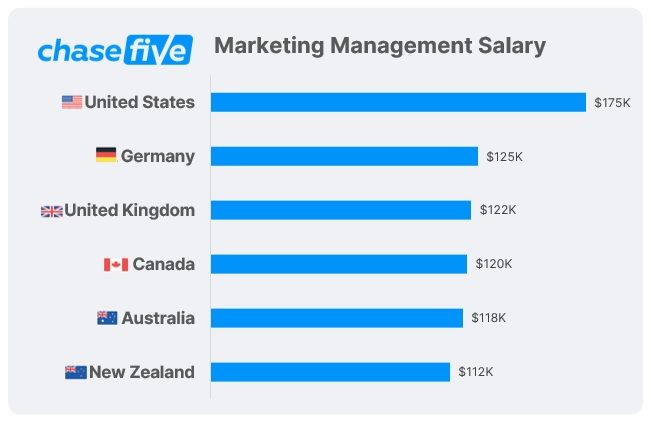
The analysis shows that the United States has the highest marketing management salary, averaging approximately $175,000 per year.


The gap between the U.S. and the second-highest market (Germany at $125,000) is substantial—around $50,000, or roughly 40% higher.


The remaining markets fall into a relatively tight salary band:


  • Germany: $125K
  • United Kingdom: $122K
  • Canada: $120K
  • Australia: $118K
  • New Zealand: $112K


This reflects the premium placed on senior marketing talent in the United States, driven by the size of the market, competition for skilled professionals, and higher executive compensation norms.


Despite smaller differences between the other markets, labor costs remain one of the most influential components of overall marketing expenses.

Chasefive Marketing Cost Index

Cost of Media Buying


Advertising costs also vary widely across markets.

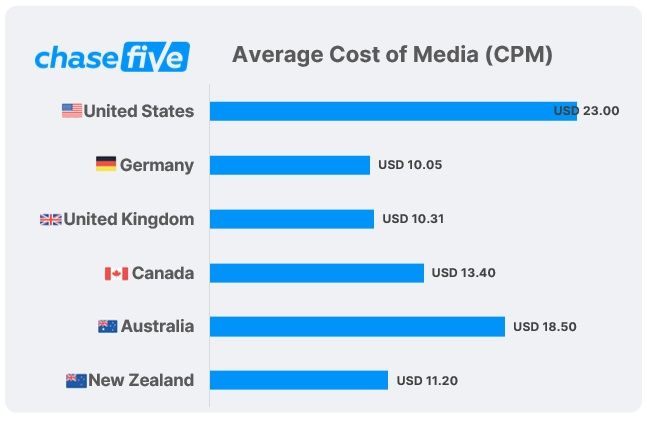
The Average Cost of Media (CPM) measures the cost of purchasing 1,000 advertising impressions. This metric provides insight into the competitiveness and maturity of each advertising ecosystem.

The analysis shows that the United States and Australia command the highest CPM premiums.

  • United States: $23.00
  • Australia: $18.50
  • Canada: $13.40
  • New Zealand: $11.20
  • United Kingdom: $10.31
  • Germany: $10.05

The United States stands out again as the most expensive advertising environment, with CPM levels more than double those of some European markets.

Australia follows as the second most expensive media buying market, likely reflecting a combination of high advertiser demand and relatively limited media inventory.

In contrast, Germany and the United Kingdom appear to offer the most cost-efficient media environments among the countries analyzed.

Chasefive Marketing Cost index

Agency Suppliers

External marketing agencies represent another important operational cost.

Agency hourly rates vary less dramatically than media costs, but clear differences still exist between markets.

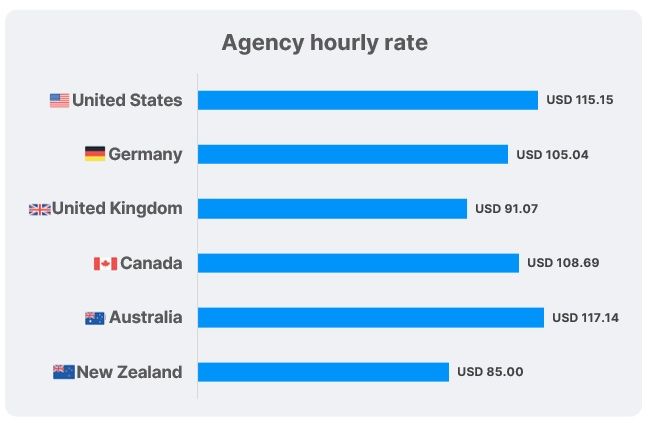
The highest agency rates appear in Australia ($117/hour) and the United States ($115/hour). These markets represent the most expensive environments for outsourced marketing production and specialist services.

Canada and Germany follow closely behind:

  • Canada: $108/hour
  • Germany: $105/hour

Interestingly, despite being one of the world's major marketing hubs, the United Kingdom shows comparatively lower agency pricing, averaging around $91/hour.

New Zealand offers the most cost-efficient agency services, with rates averaging $85/hour.

Overall, agency service pricing tends to show moderate global variation, suggesting that professional marketing services are becoming increasingly
Chasefive Marketing Index

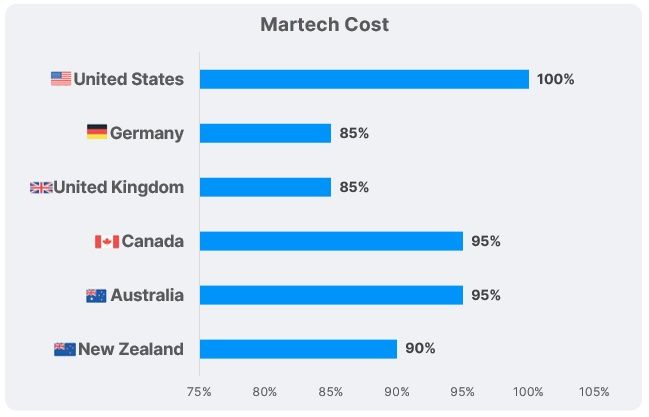
Cost of Marketing Technology

Unlike labor or media buying, marketing technology costs are far less influenced by geography.

Most major MarTech platforms originate in the United States and are typically priced globally in USD, resulting in relatively standardized pricing structures.

Using the U.S. as the reference cost level (100), the comparison shows only modest variation:

  • United States: 100%
  • Canada: 95%
  • Australia: 95%
  • New Zealand: 90%
  • Germany: 85%
  • United Kingdom: 85%

These differences may reflect currency effects, regional pricing adjustments, or purchasing power differences.

However, the key takeaway is that MarTech platforms operate largely on global pricing models, meaning companies in different countries typically pay similar amounts for the same software tools.


Key Takeaways: Geography Matters

The Global Marketing Cost Index highlights an important reality for modern marketing leaders:

Where marketing is executed can significantly influence the total cost of operations.

Several patterns emerge from the data:

  • The United States represents the highest-cost marketing environment across multiple dimensions.
  • Most other developed markets cluster within a relatively narrow cost range.
  • Media costs and talent salaries are the largest drivers of cost variation.
  • MarTech costs remain largely globalized, with minimal geographic variation.

For organizations managing global marketing operations, these insights can influence decisions about team structure, outsourcing models, and campaign execution strategies.

Understanding these structural differences can help companies optimize marketing investment efficiency while maintaining high performance standards.

To explore more insights on marketing productivity, operational performance, and marketing budget management, visit:

the FAPI Marketing Framework Academy.

Chasefive provides tools and frameworks designed to help marketing leaders bring greater
structure, accountability, and visibility to marketing operations.

By Chasefive Management February 24, 2026
Marketing is frequently misunderstood as promotion, advertising, or campaign execution. While these activities are visible outputs, they are not the core function of marketing. At its strategic core, marketing exists to shape how value is perceived before a product or service is ever experienced. The founder of the FAPI Marketing Framework™ captures this principle succinctly: “Marketing’s purpose is to create a perception of value before the product is consumed.” This statement reframes marketing from a downstream communications function into a strategic discipline responsible for shaping expectations, framing relevance, and establishing trust before a buying decision occurs.
By Chasefive Management February 18, 2026
Chasefive, a specialist marketing management advisory firm, has been recognised as MarTech Innovator of the Year 2026 in the prestigious Australian Enterprise Awards , presented by APAC Insider. Now in its ninth year, the Australian Enterprise Awards celebrate outstanding organisations across Australia that demonstrate innovation, measurable impact, and excellence within their industries. The awards recognise businesses contributing to the nation’s economic growth and global competitiveness through forward-thinking strategies and transformative solutions. Chasefive received the MarTech Innovator of the Year distinction in recognition of its pioneering work in structured marketing management and its development of the Chasefive Marketing Architecture Manager (MAM) platform. Built on the proprietary FAPI Marketing Framework™ (Frame-Architecture-Production-Insights) , the platform enables organisations to systemise marketing planning, execution, and performance measurement — improving operational clarity, accountability, and ROI. The Chasefive mission is to bring structure, discipline, and measurable impact to marketing management. This recognition reinforces the importance of aligning strategy, execution, and insights within a unified operating framework. Chasefive supports organizations across all industry sectors from technology, professional services, and industrial sectors, helping leadership teams translate business objectives into structured marketing systems. Through its advisory services and software platform, Chasefive enables companies to improve marketing productivity, strengthen go-to-market execution, and support sustainable growth. The Australian Enterprise Awards are organised by APAC Insider, a publication dedicated to showcasing business excellence and innovation across the Asia-Pacific region. Winners are selected based on merit, innovation, measurable success, and overall industry impact. For more information about the awards and winners, visit: https://apacinsider.digital/winners/chasefive-management/
By Chasefive Management February 11, 2026
Chasefive partnered with Claryx.ai to support the strategic marketing planning for the launch of Claryx..AI's AI-driven application for accounting practices BRISBANE, AUSTRALIA, February 11, 2026 Chasefive , a specialist marketing planning and advisory firm, today announced it supported Claryx.ai in the strategic planning and market introduction of its innovative Claryx AI-powered solution, designed to equip accountants and bookkeepers with actionable, client-centric advisory intelligence. Claryx.ai ( https://claryx.ai ), an emerging leader in artificial intelligence solutions for the accounting profession , has developed its software to enable accounting professionals to deliver strategic value beyond traditional compliance services. Built on advanced machine learning and real-time data analysis, Claryx synthesizes client financials, risk indicators, and growth signals into clear, actionable recommendations, giving accounting firms the ability to scale advisory offerings, deepen client relationships, and convert compliance work into high-value, billable services. To support the successful market entry of this breakthrough product, Claryx.ai engaged Chasefive to architect an end-to-end marketing planning approach tailored to the accounting and bookkeeping sector. Chasefive’s scope included: Go-to-market strategy — Defining positioning, value propositions, and target segments most receptive to AI-enabled advisory services. Messaging and positioning — Articulating key benefits that resonate with both technical and business audiences within accounting practices. Product launch planning — Developing launch roadmaps, integrated campaign structures, and channel strategies to accelerate market awareness and adoption. 
By Chasefive Management February 9, 2026
Marketing leaders rarely wake up asking for a new framework. They wake up to the sound of friction. It starts with a sense of unease: “We’re moving fast, but are we moving forward?” or “Why does the CFO look at my reports like they’re written in a dead language?” These aren’t just complaints; they are marketing diagnostic triggers . The challenge for the modern C-suite is that marketing pain is almost always expressed at the surface level, while the root cause lies deep "below the waterline"—embedded in governance, architecture, and broken operating models. This guide reframes those common frustrations into structural solutions, moving your organization from reactive symptoms to intentional design. The Diagnostic Principle: Look Below the Waterline Most marketing problems are misdiagnosed because leaders focus on the visible "wake" rather than the engine. We see: Activity without impact. Tools without ROI. Dashboards without decisions. The FAPI Marketing Framework encourages a shift in perspective. When you stop asking your team to "do more marketing" and start fixing the operating system the marketing runs on, you solve for three core deficiencies: KPI Misalignment, Martech Fragmentation, and Governance Gaps.
By Chasefive Management January 21, 2026
Establishing a truly data-driven culture goes beyond simply gathering information; it involves a significant transformation. Based on the principles of the FAPI Marketing Framework™ , raw data, which is often seen as just "noise," needs to be refined into a structured ecosystem. This evolution is essential for guiding strategic decision-making and optimizing performance. One of the core principles is clear: data without a structured approach becomes a distraction rather than a tool for success. To truly harness the value of data, teams must create a system that promotes purpose, logic, and clarity in their processes. If you're ready to move past merely collecting data and wish to cultivate marketing systems driven by insights , here’s a step-by-step guide to building that culture. 1. Establish Purpose and Benchmarks Before Execution  A data-driven culture begins with preparation. Data without structure is just noise, so the Framework mandates that the Plan Master must establish benchmarks and Key Performance Indicators (KPIs) before execution begins. Define the "Why": Teams must understand not just what is being measured, but why it serves a purpose. This avoids costly misalignment and inefficient resource allocation. The Four Pillars of Readiness: To prepare data for decision-making, the team must ensure four elements are in place: defined target metrics, data collection infrastructure, contextual data (historical trends/benchmarks), and conditional data logic. 2. Climb the "Marketing Intelligence Ladder" The framework advocates moving the team from basic reporting to strategic action by climbing the " Marketing Intelligence Ladder. " A data-driven culture evolves through these stages: Descriptive & Diagnostic: Moving beyond simple Reporting (what happened) to Analysis (why it happened). Predictive: Using Forecasting and Predictive Analysis to anticipate future outcomes like churn risk or lead volume. Prescriptive: The ultimate goal is Prescriptive Analysis , where data answers the question, "What should we do about it?" recommending concrete actions to maximize impact. 3. Implement "Data Conditionality" To remove bias and guesswork, the framework introduces the principle of Data Conditionality . This involves establishing pre-defined outcomes based on specific results using "If [Condition], Then [Action]" logic. Automated Decisioning: By defining these rules in advance (e.g., "If engagement drops below X, trigger Campaign Y"), teams can react immediately to data shifts without arbitrary debate. Proactive vs. Reactive: This logic allows for both reactive adjustments to performance and proactive preparation for anticipated trends.
By Chasefive Management January 19, 2026
The FAPI Marketing Framework Academy today announced the release of its 2026 Certification Course , representing the most significant evolution of its training program to date. Now expanded to 54 comprehensive lessons , the 2026 edition transforms the curriculum from a strategy workshop into a full-scale operational certification pathway designed to help organizations move from campaign execution to marketing organizational planning. 
More posts