
How to build a data driven culture in marketing teams. Transforming marketing data from "noise" into operational insights
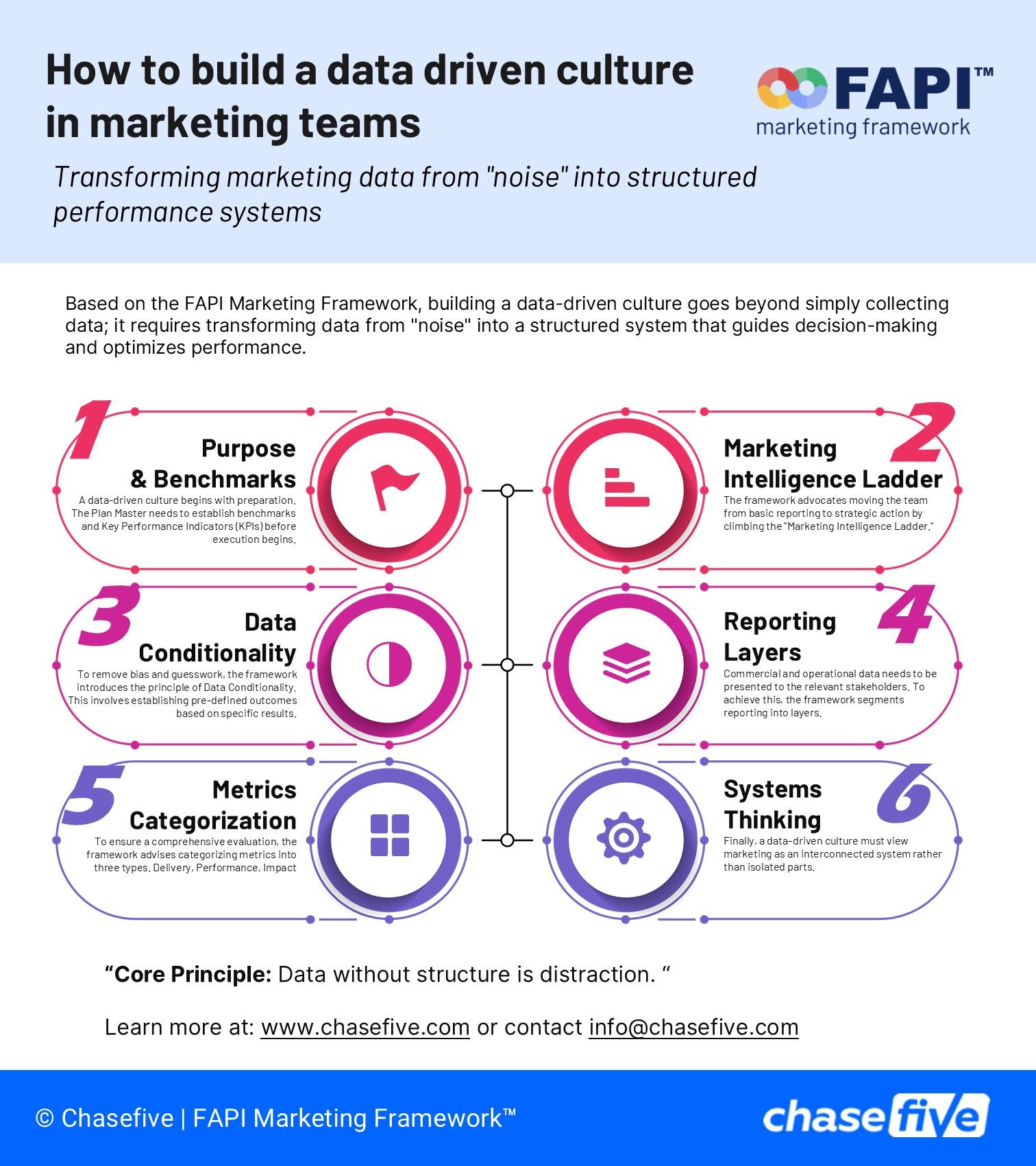
Establishing a truly data-driven culture goes beyond simply gathering information; it involves a significant transformation. Based on the principles of the FAPI Marketing Framework™, raw data, which is often seen as just "noise," needs to be refined into a structured ecosystem. This evolution is essential for guiding strategic decision-making and optimizing performance.
One of the core principles is clear: data without a structured approach becomes a distraction rather than a tool for success. To truly harness the value of data, teams must create a system that promotes purpose, logic, and clarity in their processes.
If you're ready to move past merely collecting data and wish to cultivate marketing systems driven by insights, here’s a step-by-step guide to building that culture.
1. Establish Purpose and Benchmarks Before Execution
A data-driven culture begins with preparation. Data without structure is just noise, so the Framework mandates that the Plan Master must establish benchmarks and Key Performance Indicators (KPIs) before execution begins.
- Define the "Why": Teams must understand not just what is being measured, but why it serves a purpose. This avoids costly misalignment and inefficient resource allocation.
- The Four Pillars of Readiness: To prepare data for decision-making, the team must ensure four elements are in place: defined target metrics, data collection infrastructure, contextual data (historical trends/benchmarks), and conditional data logic.
2. Climb the "Marketing Intelligence Ladder"
The framework advocates moving the team from basic reporting to strategic action by climbing the "Marketing Intelligence Ladder." A data-driven culture evolves through these stages:
- Descriptive & Diagnostic: Moving beyond simple Reporting (what happened) to Analysis (why it happened).
- Predictive: Using Forecasting and Predictive Analysis to anticipate future outcomes like churn risk or lead volume.
- Prescriptive: The ultimate goal is Prescriptive Analysis, where data answers the question, "What should we do about it?" recommending concrete actions to maximize impact.
3. Implement "Data Conditionality"
To remove bias and guesswork, the framework introduces the principle of Data Conditionality. This involves establishing pre-defined outcomes based on specific results using "If [Condition], Then [Action]" logic.
- Automated Decisioning: By defining these rules in advance (e.g., "If engagement drops below X, trigger Campaign Y"), teams can react immediately to data shifts without arbitrary debate.
Proactive vs. Reactive: This logic allows for both reactive adjustments to performance and proactive preparation for anticipated trends.
4. Rationalize Metrics for Different Stakeholders
A common failure in data culture is the "KPI Divide," where operational data (like clicks) is presented to leadership who care about commercial growth. To solve this, the framework segments reporting into three layers:
- Commercial Metrics: For the C-suite (e.g., ROMI, revenue impact).
- Management Metrics: For the Plan Master (e.g., funnel conversion, user journey flow).
- Production Metrics: For Production Executives (e.g., email open rates, ad impressions). By tailoring reports, every stakeholder receives insights relevant to their decision-making level, fostering trust and clarity.
5. Categorize Metrics: Delivery, Performance, Impact
To ensure a comprehensive evaluation, the framework advises categorizing metrics into three types:
- Delivery Metrics: Quantitative measures of execution (e.g., number of ads displayed).
- Performance Metrics: Qualitative marketing outcomes (e.g., engagement rates, satisfaction scores).
- Impact Metrics: Long-term strategic effects (e.g., market share, Customer Lifetime Value).
6. Adopt Systems Thinking
Finally, a data-driven culture must view marketing as an interconnected system rather than isolated parts.
- The Leverage Effect: Teams must understand that marketing activities interact to produce a collective output greater than the sum of individual efforts. Data analysis should look for these synergies.
- Correlational Attribution: Instead of relying on single-touchpoint metrics (like last-click), teams should analyze correlations across the entire user journey to understand true performance.
By following these key steps, marketing teams can establish a robust data-driven culture that transforms data into a valuable asset for decision-making and strategic growth.
Learn more in the FAPI Marketing Framework™ Academy at
https://www.chasefive.com/fapi-marketing-academy