
This creates unrealistic expectations, poorly defined job descriptions, overlapping responsibilities and, ultimately, gaps in accountability.
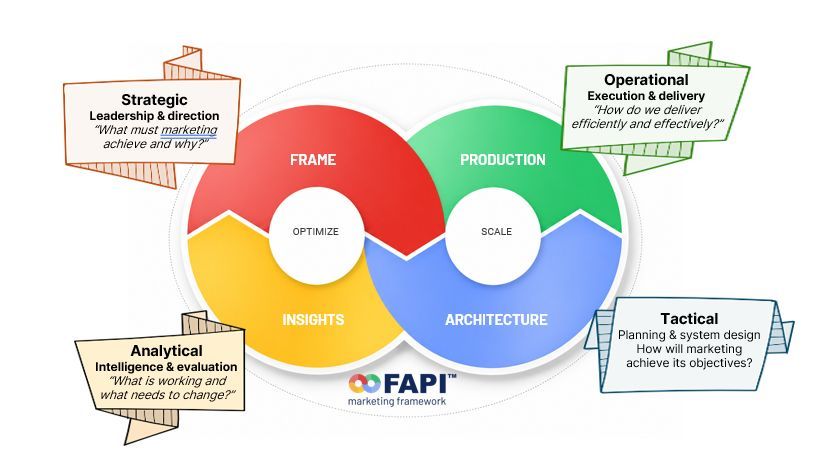
The FAPI Marketing Framework™ addresses this challenge by structuring the marketing function into four interconnected management dimensions, each requiring distinct competencies, professional qualifications, decision-making capabilities and areas of ownership.
- Frame Module — Strategic Dimension
- Architecture Module — Tactical Dimension
- Production Module — Operational Dimension
- Insights Module — Analytical Dimension
Understanding these distinctions is fundamental to designing an effective marketing organisational structure, allocating resources, recruiting talent and establishing a clear Chain of Accountability.
1. Frame Module — The Strategic Dimension
Core competency: Commercial leadership and strategic direction
The Frame Module establishes the strategic foundations of the marketing function. It ensures that marketing operates as an integral component of the business strategy rather than as an isolated promotional function.
Professionals operating within this dimension must understand the broader commercial environment, organisational priorities, competitive dynamics and financial implications of marketing decisions.
Their primary responsibility is to determine what marketing must achieve, why those objectives matter and within which commercial and financial parameters the function must operate.
Roles and responsibilities
| Area of ownership | Responsibilities |
|---|---|
| Strategic direction | Establishing marketing priorities aligned with business objectives. |
| Market strategy | Defining target markets, audience segments and competitive positioning. |
| Brand strategy | Establishing brand purpose, positioning and value proposition. |
| Financial governance | Determining investment priorities and marketing budget parameters. |
| Commercial accountability | Establishing marketing's expected contribution to business outcomes. |
| Executive alignment | Managing stakeholder expectations and executive-level reporting. |
Skills, professional roles and qualifications
Qualifications within this dimension emphasise corporate governance, financial literacy, strategic thinking and commercial leadership rather than channel-specific execution.
| Category | Professional requirements |
|---|---|
| Core competencies | Corporate governance, financial literacy, strategic thinking, commercial leadership and executive stakeholder management. |
| Typical professional roles | Chief Marketing Officer (CMO), Marketing Director, Head of Marketing, VP of Marketing, Chief Strategy Officer and Marketing Strategy Consultant. |
| Academic and formal education | MBA with a focus on strategy or finance; degree in Business Administration, Economics, Commerce, Marketing or Corporate Finance. |
| Certifications and credentials | Executive leadership programmes, Chartered Marketer credentials and corporate governance qualifications, including programmes offered by Harvard Business School, INSEAD and the Australian Institute of Company Directors (AICD). |
| Experiential qualifications | Typically 10+ years of progressive leadership experience, including exposure to P&L accountability, executive reporting, pricing strategy, market development and substantial budget allocation. |
| Primary accountability | Strategic alignment and commercial contribution. |
2. Architecture Module — The Tactical Dimension
Core competency: Marketing system design and resource orchestration
The Architecture Module translates strategic direction into a structured, measurable and executable marketing system.
Where the Strategic Dimension determines what must be achieved, the Tactical Dimension determines how marketing activities, resources, channels, technologies and suppliers must be organised to achieve those objectives.
This requires a combination of systems thinking, commercial understanding, cross-functional coordination and planning capabilities.
Marketing professionals operating within this dimension act as architects of the marketing function, designing the mechanisms through which strategy becomes operational reality.
Within the FAPI Marketing Framework, the Plan Master plays a central role in maintaining the connection between strategic direction, tactical planning and operational delivery.
Roles and responsibilities
| Area of ownership | Responsibilities |
|---|---|
| Marketing planning | Translating strategic objectives into structured marketing plans. |
| Activity architecture | Defining marketing activities, programmes and their interdependencies. |
| Customer journey | Mapping touchpoints and marketing activities across the customer lifecycle. |
| Resource allocation | Distributing budgets across labour, media and tools. |
| Performance planning | Establishing activity-level KPIs, targets and performance thresholds. |
| Supplier management | Defining scopes of work, deliverables and service-level requirements. |
| Technology architecture | Coordinating the integration of marketing systems and platforms. |
Skills, professional roles and qualifications
Qualifications within this dimension combine marketing management, systems design, project governance and commercial operations.
| Category | Professional requirements |
|---|---|
| Core competencies | Systems thinking, integrated marketing planning, resource orchestration, project governance and commercial operations. |
| Typical professional roles | Marketing Operations Manager, Marketing Architect, Marketing Manager, Integrated Marketing Manager, Product Marketing Manager, Revenue Operations Manager and Marketing Programme Manager. |
| Academic and formal education | Bachelor's or master's degree in Marketing, Information Systems, Business Analytics, Operations Management, Industrial Engineering or Business Administration. |
| Certifications and credentials | Project Management Professional (PMP), PRINCE2, Certified ScrumMaster, Marketing Operations, Revenue Operations and relevant MarTech qualifications. |
| Experiential qualifications | Typically 5–10 years in marketing management, marketing operations, integrated planning or management consulting. Experience in customer lifecycle mapping, cross-functional resource coordination, budget management and MarTech integration. |
| Primary accountability | Tactical effectiveness, resource allocation and alignment between strategy and execution. |
3. Production Module — The Operational Dimension
Core competency: Technical expertise, execution and operational efficiency
The Production Module is responsible for transforming marketing plans into tangible deliverables.
This is the dimension in which marketing campaigns are launched, content is produced, websites are maintained, advertising is managed and customer-facing communications are deployed.
Professionals operating within this dimension require specialised technical competencies, execution discipline and the ability to deliver high-quality work within defined budgets, timelines and performance requirements.
The objective is not simply to produce more marketing output, but to deliver the right output efficiently, consistently and in accordance with tactical requirements.
Roles and responsibilities
| Area of ownership | Responsibilities |
|---|---|
| Campaign execution | Implementing campaigns across designated channels. |
| Content production | Developing creative assets, copy and marketing collateral. |
| Channel operations | Managing advertising, SEO, email, social media and other channels. |
| Technical implementation | Configuring platforms, integrations and tracking mechanisms. |
| Production workflows | Managing tasks, sprints, dependencies and delivery schedules. |
| Quality assurance | Ensuring deliverables meet brand, technical and contractual standards. |
| Delivery verification | Providing evidence of execution against agreed scopes of work. |
Skills, professional roles and qualifications
Qualifications within the Operational Dimension centre on demonstrable technical expertise, practical experience and the ability to deliver measurable outputs.
| Category | Professional requirements |
|---|---|
| Core competencies | Technical expertise, creative production, channel management, execution discipline, quality assurance and operational efficiency. |
| Typical professional roles | Digital Marketing Specialist, Content Manager, Graphic Designer, Copywriter, SEO Specialist, Paid Media Specialist, CRM Specialist, Email Marketing Specialist, Web Developer and Marketing Coordinator. |
| Academic and formal education | Degree, associate degree or specialised diploma in Communications, Graphic Design, UX Design, Digital Media, Journalism, Computer Science or Marketing. |
| Certifications and credentials | Google Ads and Analytics certifications, Meta media buying qualifications, HubSpot or Klaviyo certifications and relevant UX/UI or technical accreditations. |
| Experiential qualifications | Typically 2–5+ years of hands-on agency or in-house execution experience, supported by a portfolio of completed projects, adherence to standard operating procedures and scopes of work, and familiarity with Agile, Kanban or sprint-based production workflows. |
| Primary accountability | Delivery quality, execution compliance and operational efficiency. |
External agencies, freelancers and specialist marketing suppliers may also operate predominantly within this dimension.
4. Insights Module — The Analytical and Decisional Dimension
Core competency: Marketing intelligence and evidence-based decision-making
The Insights Module closes the loop, transforming raw performance data into a self-correcting system of continuous improvement.
Its purpose extends beyond conventional marketing reporting. It involves interpreting performance, identifying inefficiencies, evaluating commercial contribution and generating actionable intelligence that informs decisions across the other three dimensions.
Professionals operating within this dimension must combine analytical rigour with commercial understanding and the ability to communicate complex findings to different levels of management.
Roles and responsibilities
| Area of ownership | Responsibilities |
|---|---|
| Data architecture | Establishing reliable data collection and measurement systems. |
| Performance evaluation | Assessing results against predefined KPIs and thresholds. |
| Commercial impact | Evaluating marketing's contribution to revenue, profitability and growth. |
| Attribution | Analysing the relationship between marketing touchpoints and outcomes. |
| Experimentation | Designing tests and validating performance hypotheses. |
| Forecasting | Identifying trends, risks and potential future outcomes. |
| Decision support | Translating findings into actionable management recommendations. |
| Continuous improvement | Identifying opportunities for optimisation and resource reallocation. |
Skills, professional roles and qualifications
Qualifications within this dimension emphasise statistical literacy, data management, analytical methodologies and executive-level data storytelling.
| Category | Professional requirements |
|---|---|
| Core competencies | Statistical literacy, data management, analytical reasoning, performance evaluation, commercial intelligence and executive data storytelling. |
| Typical professional roles | Marketing Analyst, Marketing Intelligence Manager, Business Intelligence Analyst, Data Scientist, Marketing Performance Manager, Attribution Specialist and Customer Insights Manager. |
| Academic and formal education | Bachelor's or master's degree in Data Science, Statistics, Econometrics, Applied Mathematics, Quantitative Marketing, Economics or Business Intelligence. |
| Certifications and credentials | Microsoft Power BI, Tableau, cloud data engineering certifications and specialised training in attribution or Marketing Mix Modelling (MMM). |
| Experiential qualifications | Typically 4–8 years in marketing analytics, business intelligence or related quantitative disciplines. Depending on the role, relevant capabilities may include SQL, Python, R, attribution modelling, experimental design and the ability to translate technical performance data into commercially meaningful metrics. |
| Primary accountability | Measurement integrity, actionable intelligence and evidence-based decision support. |
Mapping Skills and Accountability Across the Four Dimensions
The distinction between the four dimensions becomes particularly important when defining professional responsibilities and establishing performance expectations.
| Attribute | Frame | Architecture | Production | Insights |
|---|---|---|---|---|
| Management dimension | Strategic | Tactical | Operational | Analytical |
| Core capability | Leadership | Systems thinking | Technical expertise | Analytical reasoning |
| Primary focus | Direction | Planning | Execution | Evaluation |
| Key deliverable | Marketing strategy | Marketing architecture and plan | Marketing outputs | Marketing intelligence |
| Resource focus | Investment priorities | Resource allocation | Resource utilisation | Resource effectiveness |
| Decision focus | What and why | How and with what | Implementation | What needs to change |
| Accountability | Commercial alignment | Tactical performance | Delivery and quality | Measurement and intelligence |
| Indicative experience | 10+ years | 5–10 years | 2–5+ years | 4–8 years |
These experience ranges and qualifications are illustrative rather than mandatory requirements of the FAPI Marketing Framework. Professional suitability should ultimately be determined by demonstrated competencies, organisational complexity and the scope of responsibility.
The Chain of Accountability: Connecting Ownership and Responsibility
One of the fundamental principles of the FAPI Marketing Framework is that accountability must follow the structure of the marketing management system.
Strategic leaders should not delegate responsibility for defining commercial objectives to operational specialists. Similarly, operational teams should not be expected to compensate for deficiencies in strategic direction or tactical planning.
The Chain of Accountability connects the four dimensions through clearly defined management responsibilities, deliverables and areas of accountability.
| Dimension | Management responsibility | Key deliverable | Accountability |
|---|---|---|---|
| Strategic
Frame Module |
Define objectives and investment priorities. | Marketing strategy | Commercial alignment |
| Tactical
Architecture Module |
Translate objectives into measurable plans. | Marketing architecture and plan | Tactical effectiveness |
| Operational
Production Module |
Deliver against defined requirements. | Marketing outputs | Delivery quality and efficiency |
| Analytical
Insights Module |
Evaluate results and inform continuous improvement. | Marketing intelligence | Measurement and decision support |
Each dimension has a distinct area of ownership, but its effectiveness depends on the quality of the inputs received from the other dimensions.
A poorly defined strategy leads to fragmented tactical planning. Fragmented tactical planning leads to inefficient production. Inadequate measurement prevents the organisation from identifying and correcting these deficiencies.
Marketing performance is therefore not exclusively the responsibility of the professionals executing campaigns. It is the collective outcome of an interconnected management system.
This principle is fundamental to adopting a systems-based approach to marketing management.
Not Every Marketing Professional Needs to Master All Four Dimensions
A common misconception in marketing recruitment is that professional seniority automatically implies proficiency across every marketing discipline.
An experienced marketing strategist may have exceptional commercial leadership capabilities without possessing advanced technical advertising skills. A highly skilled digital marketing specialist may excel at campaign execution without having the financial or strategic competencies required to manage an entire marketing function.
Similarly, a marketing analyst may identify significant performance improvement opportunities without being the appropriate person to implement the resulting operational changes.
These are not necessarily professional shortcomings. They reflect the natural specialisation of competencies within a multidisciplinary function.
The challenge for organisations is to ensure that all four dimensions are adequately represented within their marketing capabilities, rather than expecting every individual to master them all.
Four Management Dimensions Do Not Necessarily Require Four Departments
The FAPI Marketing Framework does not prescribe a rigid organisational hierarchy or require businesses to establish four separate marketing departments.
In a small business, a Head of Marketing may assume ownership of both the Strategic and Tactical Dimensions, while external agencies provide operational expertise and a shared business intelligence resource supports the Analytical Dimension.
In larger enterprises, each dimension may be supported by dedicated teams, specialist managers and external service providers.
Applying the Four Dimensions Across Different Organisational Structures
| Management dimension | Small business | Mid-market business | Large enterprise |
|---|---|---|---|
| Strategic
Frame Module |
Business Owner, CEO or Fractional Head of Marketing | Head of Marketing or Marketing Director | CMO and strategic leadership team |
| Tactical
Architecture Module |
Marketing Manager or external consultant | Marketing Manager and Marketing Operations specialists | Dedicated marketing planning, architecture and operations teams |
| Operational
Production Module |
External agencies, freelancers or Marketing Coordinator | Internal specialists supported by external suppliers | Dedicated production, creative and channel teams |
| Analytical
Insights Module |
Shared analytical resource or external specialist | Marketing Analyst or Business Intelligence specialist | Dedicated marketing intelligence, analytics and data science teams |
These organisational structures are illustrative. The FAPI Marketing Framework does not prescribe a fixed organisational hierarchy.
The same individual may operate across multiple dimensions. What matters is that the distinction between their responsibilities, competencies and decision-making authority remains clear.
From Job Descriptions to Marketing Capability Architecture
Organisations can apply the four-dimensional structure of the FAPI Marketing Framework to move beyond conventional job descriptions and develop a more comprehensive marketing capability architecture.
This approach enables business leaders to:
- Identify competency gaps within the marketing function.
- Recruit professionals against clearly defined management requirements.
- Allocate decision-making authority to the appropriate level.
- Reduce overlapping responsibilities and organisational friction.
- Establish appropriate performance expectations for each role.
- Determine which capabilities should be retained internally or outsourced.
- Develop professional training and career progression pathways.
- Strengthen financial accountability and resource utilisation.
Rather than simply asking whether the organisation has enough marketing staff, business leaders should ask whether it has the right combination of strategic, tactical, operational and analytical capabilities.
The Chasefive Marketing Architecture Manager (MAM) supports the practical implementation of this approach by connecting marketing planning, resource allocation, activity management and performance accountability within a unified management environment.
Conclusion: Marketing Performance Is a Multidisciplinary Responsibility
Effective marketing requires more than creative talent, technical proficiency or strategic vision in isolation. It requires the coordinated application of four complementary disciplines.
The Strategic Dimension provides direction.
The Tactical Dimension designs the system.
The Operational Dimension delivers the work.
The Analytical Dimension evaluates performance and informs continuous improvement.
By establishing clear boundaries of ownership while maintaining interdependence between these dimensions, the FAPI Marketing Framework™ provides organisations with a structured approach to building marketing teams that are commercially aligned, professionally specialised, operationally efficient and accountable for performance.
The maturity of a marketing function should not be measured solely by the size of its team, the sophistication of its technology or the volume of its output, but by its ability to integrate all four management dimensions into a coherent, accountable and continuously improving system.