
The Marketing Chain of Accountability in the FAPI Marketing Framework
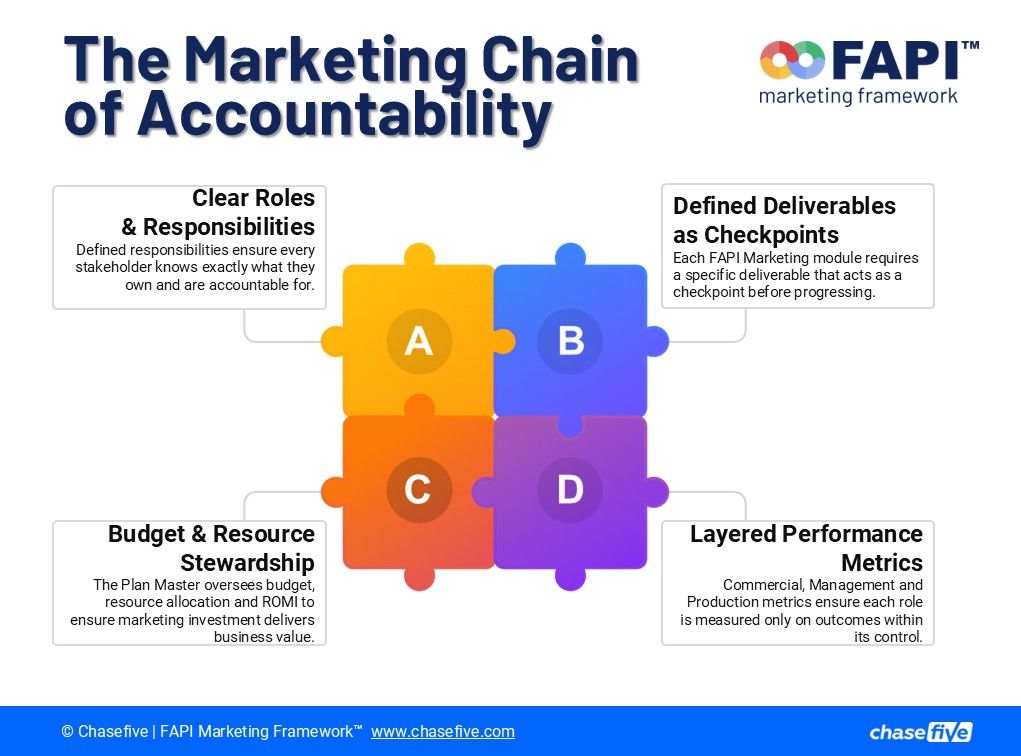
By defining exactly who is responsible for what and when, the FAPI Framework's chain of accountability eliminates the "us vs. them" mentality, minimizes misalignment, and guarantees that every marketing effort actively contributes to the organization's overarching business goals.
1. Clear Roles and Responsibilities
Accountability flows through specific, clearly defined roles so that every stakeholder knows their exact contribution:
- The Leadership Team (C-Suite): Accountable for guiding the organization by setting overarching strategic direction, tracking milestones, and evaluating the overall Return on Marketing Investment (ROMI).
- The Plan Master: Accountable for overseeing the project, building the team, managing the budget, and translating leadership's vision into an operational blueprint.
- Functional Leads: Accountable for providing cross-functional support, expertise, and coordinating necessary resources from their respective departments.
- Production Executives: Accountable for the hands-on execution of specific marketing tasks, ensuring that delivered work meets high-quality standards and aligns with brand messaging.
2. Defined Deliverables as Checkpoints
To make progress visible and keep stakeholders accountable at every phase, the framework enforces strict deliverables that serve as milestones:
- Frame Module: Deliverable is the
Strategy Brief, holding leadership accountable for defining and agreeing upon strategic direction before any work begins.
- Architecture Module: Deliverable is the
Marketing Playbook, holding the Plan Master accountable for finalizing a detailed operational blueprint before committing resources.
- Production Module: Deliverable consists of the
marketing activities themselves, holding Production Executives accountable for tangible execution and output.
- Insights Module: Deliverable consists of marketing reports and recommended actions, holding the team accountable for continuous, data-driven optimization.
3. Layered Performance Measurement
The framework ensures accountability through precise, data-driven decision-making. It segments metrics into three distinct layers—Commercial, Management, and Production—so each stakeholder is evaluated exclusively on the metrics within their direct control.
Within the FAPI Marketing Framework, Layered Performance Measurement is the principle that marketing performance should be measured at multiple organizational levels, with each stakeholder accountable only for the metrics they can directly influence.
4. Budgetary and Resource Stewardship
The FAPI Framework heavily emphasizes efficient resource use. The
Plan Master is held financially accountable for overseeing the budget and ensuring resource allocation translates into a positive ROMI.
Transforming Accountability into a Competitive Advantage
Ultimately, the FAPI Marketing Framework transforms accountability from a burden into a competitive advantage. By establishing clear ownership, tangible milestones, layered metrics, and strict resource stewardship, organizations eliminate ambiguity and ensure every marketing effort drives measurable business growth.
By aligning clear roles with strict deliverables and targeted metrics, the FAPI Framework creates a seamless operational flow.
- Clear ownership removes friction across teams.
- Defined deliverables prevent wasted effort.
- Layered metrics ensure fair, relevant evaluation.
- Financial stewardship maximizes bottom-line ROMI.
When every link in the chain holds firm, marketing evolves from a cost center into a reliable driver of long-term commercial success.