
From Tactical Execution to Systematic Marketing Engine: Elevating Strategy Through the FAPI Marketing Framework
What truly separates a good marketing strategy from a great one?
In today’s fast-paced business landscape, the distinction rarely comes down to creative flair alone. Instead, it hinges on moving away from reactive, fragmented tactics and building a systematic, highly integrated business engine. While a good strategy might produce catchy campaigns and track baseline operational metrics, a great strategy bridges the gap between high-level business vision and daily execution.
Within the FAPI Marketing Framework, this shift requires a fundamental evolution in how marketing is designed, structured, and measured. Here is what sets a market-leading strategy apart from a merely good one:
1. Unified Ecosystems vs. Channel Silos
- The Good: Teams are organized rigidly by channel—such as an isolated "email team" or "social team"—which frequently leads to competing internal priorities and mismatched customer messaging.
- The Great: An integrated view takes precedence. A great strategy ensures that every stage of the customer journey, message, and campaign is completely unified beneath a single strategic direction.
2. C-Suite Alignment vs. Departmental Isolation
- The Good: Marketing strategies are often developed within the marketing department in a vacuum, forcing teams to guess broader corporate goals.
- The Great: Strategy originates fundamentally as a core component of the broader business plan. Within the FAPI framework, the overarching direction (the Frame) is established by executive leadership and the board. Non-negotiable boundaries—such as commercial objectives, pricing models, and target audiences—are locked in before any tactical work begins.
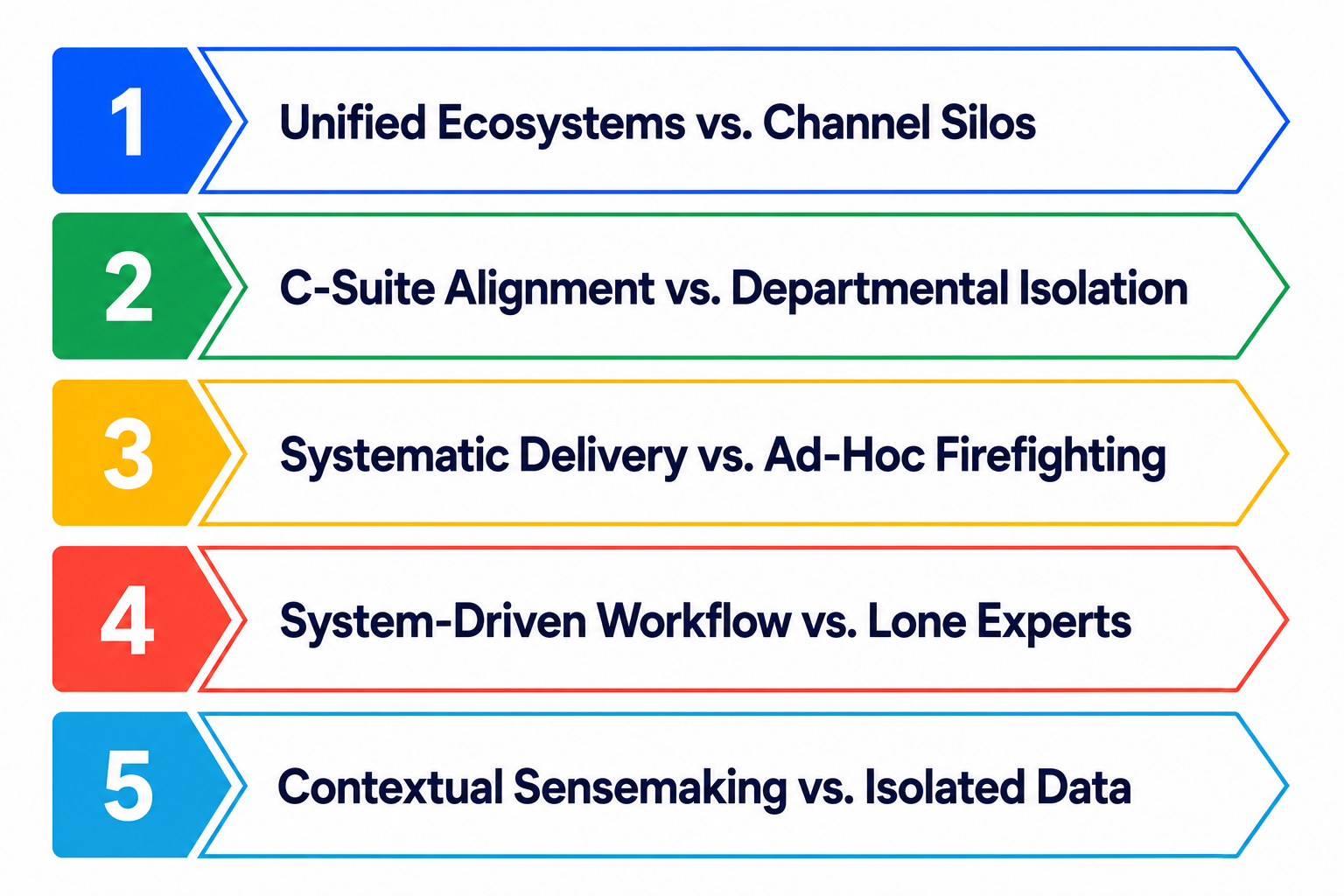
3. Systematic Delivery vs. Ad-Hoc Firefighting
- The Good: Execution relies on last-minute improvisation, guesswork, or high-stress rushes to hit launch dates.
- The Great: Structured operational design replaces panic. A great strategy demands that a detailed tactical blueprint—the
Marketing Playbook—is finalized in full before any budgets or resources are committed to production.
4. System-Driven Workflow vs. Lone Experts
- The Good: Results depend entirely on individual star performers, creating operational bottlenecks and leaving performance fragile to staff turnover.
- The Great: Responsibilities are distributed across a clearly defined, resilient team structure—utilizing distinct roles like
Plan Masters,
Functional Leads, and
Production Executives. This systematic approach builds a scalable model that delivers predictable outcomes regardless of team changes.
5. Contextual Sensemaking vs. Isolated Data
- The Good: Teams track granular metrics like cost-per-click (CPC) or bounce rates in isolation, missing the bigger financial picture.
- The Great: Data is evaluated through
contextual sensemaking during the Insights phase. Metrics are assessed against overarching business goals and commercial impacts like Return on Marketing Investment (ROMI). Furthermore, by using conditional data logic ("if X condition occurs, then execute Y action"), the strategy becomes a self-correcting system that continuously optimizes itself over time.
The Bottom Line
A great marketing strategy does not just generate short-term attention—it is intentionally engineered to operate within defined business boundaries. By transitioning from ad-hoc campaigns to a systematic framework, every creative asset and tactical effort contributes directly to measurable, predictable commercial outcomes.