FAPI Marketing Framework

Marketing Governance

Efficiency & Alignment

Building a modern marketing capability and infrastructure that is scalable and profitable through the FAPI Marketing Framework starts with a conversation.
FAPI Marketing Framework official

Supporting Business Leaders

Address Modern Marketing Challenges

Chasefive is a marketing management consulting firm and software platform that helps organizations plan, execute, and measure marketing with a structured, data-driven approach. Built on the FAPI Marketing Framework™, it aligns strategy, resources, and performance to improve productivity, accountability, and ROI.
Change marketing direction

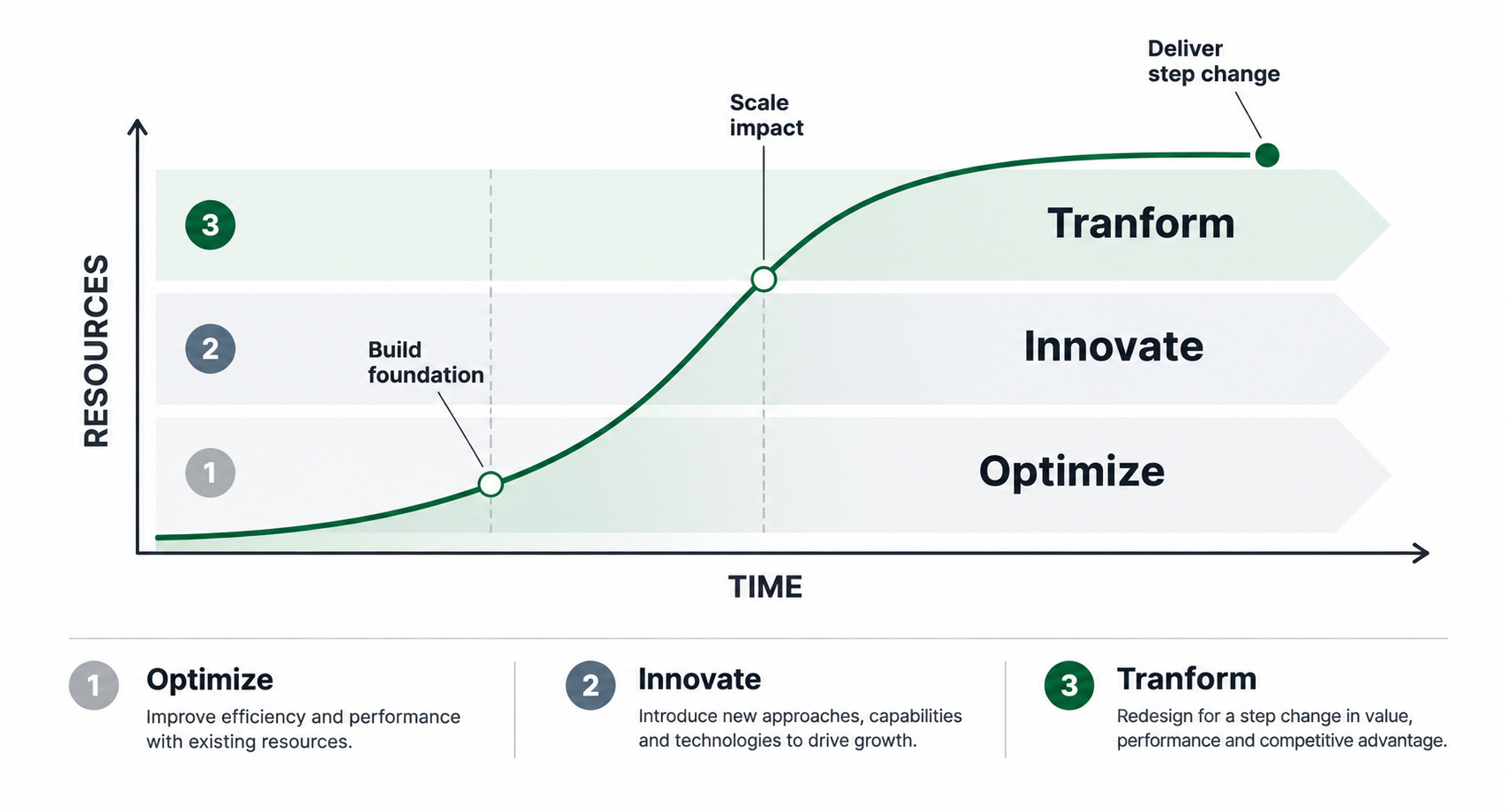
Re-engineer your marketing model to shift the marketing direction and alter your business's core value proposition, target audience, or channels to market

Identify marketing opportunities

Adopt a proactive approach in identifying and pursuing new marketing opportunities and technologies capitalizing on innovation

Improve marketing performance

Focus on enhancing your current marketing performance. Streamline marketing processes, capability resources and optimize execution potential
Change marketing direction

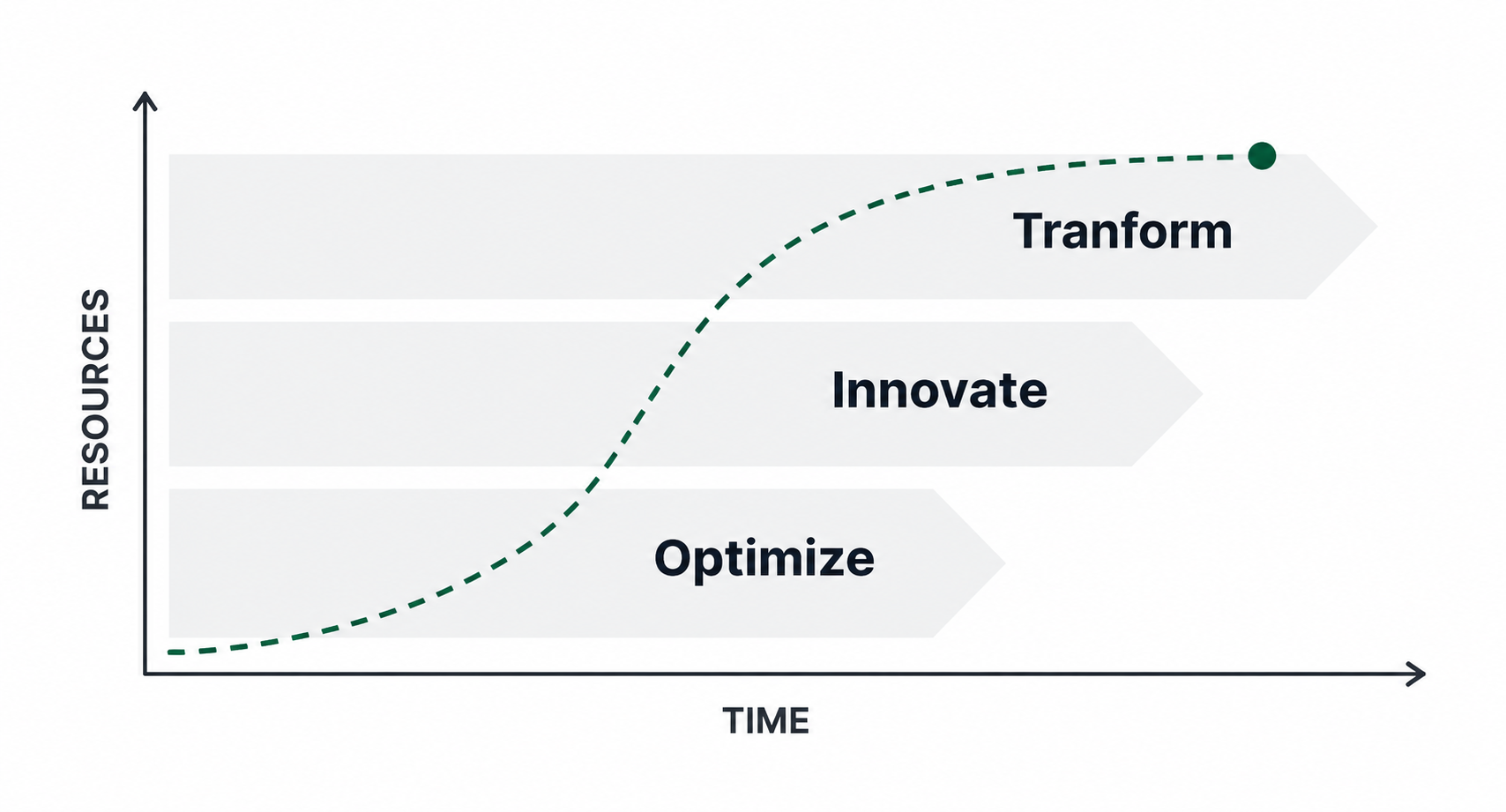
Re-engineer your marketing model to shift the marketing direction and alter your business's core value proposition, target audience, or channels to market

Identify marketing opportunities

Adopt a proactive approach in identifying and pursuing new marketing opportunities and technologies capitalizing on innovation

Improve marketing performance

Focus on enhancing your current marketing performance. Streamline marketing processes, capability resources and optimize execution potential

Strategic Vision, Practical Support

& Expert Knowledge

Customer success is our priority, whether it means developing marketing strategies and plans or supporting marketing execution. We provide comprehensive support and guidance to businesses at any stage of their marketing lifecycle by developing customized strategies tailored to each client's specific needs.

Marketing Strategy

Review your organization's overall approach and direction chosen to achieve its marketing objectives

Tactical Planning

Map the specific actions and initiatives that support the implementation of your strategy

Project Management

Develop a systematic process of planning, executing, and controlling marketing projects

Team Training

Enhance the skills, knowledge, and capability within a team to improve performance

Resources Planning

Evaluate and assessing the available resources, such as budget, personnel, and tools

Function Realignment

Reorganize the marketing functional area to align with strategic objectives

Creating Marketing Value Through

Structured Marketing Strategy & Execution

We help you create tailored marketing experiences that recognize the unique and subjective nature of your organization's relationship with its customers, leading to effective, engaging, and ultimately more successful marketing performance.
An Integrated Approach to Improve

Marketing Productivity and ROI

Marketing Management

Consulting

Chasefive provides hands-on marketing management consulting to help organizations structure, align, and operationalize their marketing function. Working with business leaders, we define clear objectives, establish strategic direction, and translate plans into executable systems. 

Learn more

FAPI Marketing Framework™

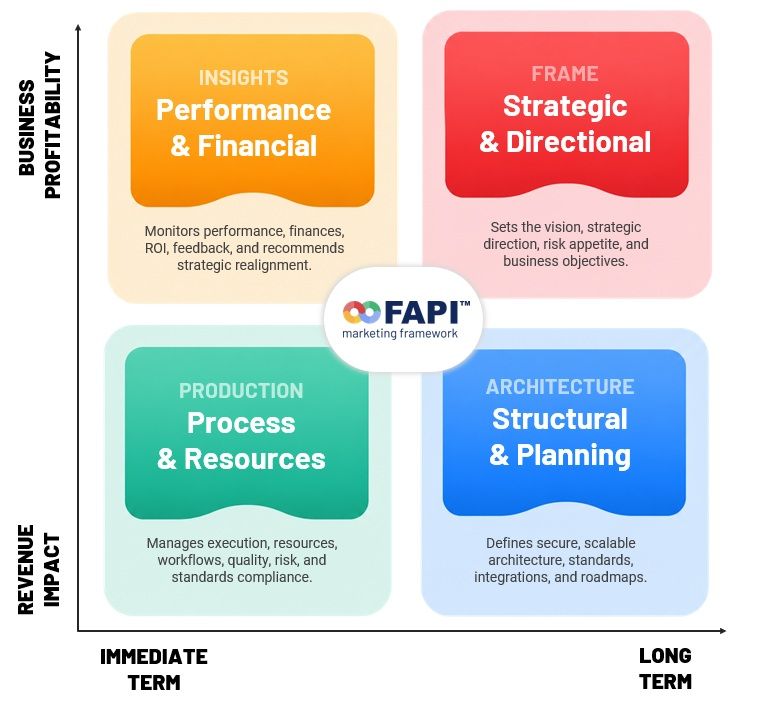
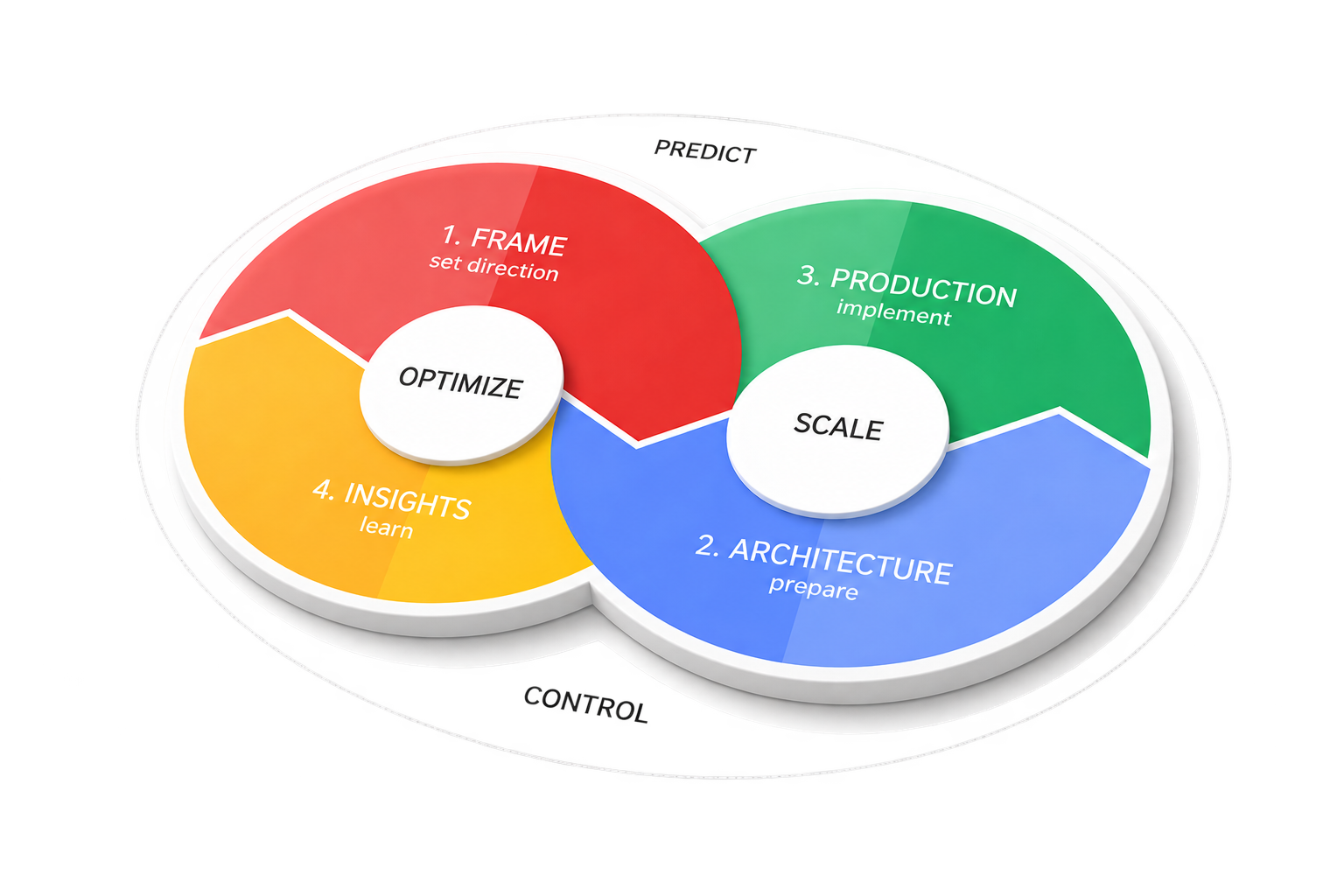
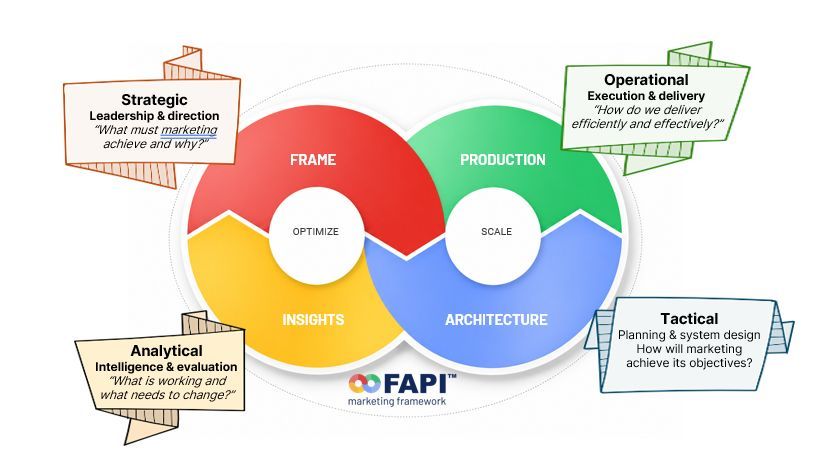
The FAPI Marketing Framework™ is Chasefive’s proprietary methodology for designing and managing marketing systems. Structured across four sequential modules, Frame, Architecture, Production, and Insights, it provides a complete model for encoding strategy, building execution systems, and measuring performance. 

Learn more

Marketing Architecture Management App

The Marketing Architecture Management (MAM) App is a purpose-built platform that acts as a control center for marketing operations. It centralizes marketing planning, budgeting, execution tracking, resources management and performance reporting in a single environment, enabling marketing management best practice.

Learn more

Marketing Resources & Insights

Find information and tools for individuals and organizations looking to enhance your team's marketing management skills. Practical guides, templates, and articles on various topics such as leadership, project management, and team building.
By Chasefive Management • November 28, 2026
Modern marketing is a multidisciplinary business function that requires a diverse range of competencies, from corporate strategy and commercial planning to technical execution and performance analytics. Yet many organisations continue to treat marketing expertise as a single professional discipline, expecting individuals to demonstrate equal proficiency in strategic leadership, tactical planning, operational execution and analytical decision-making.
By Chasefive Management • November 16, 2026
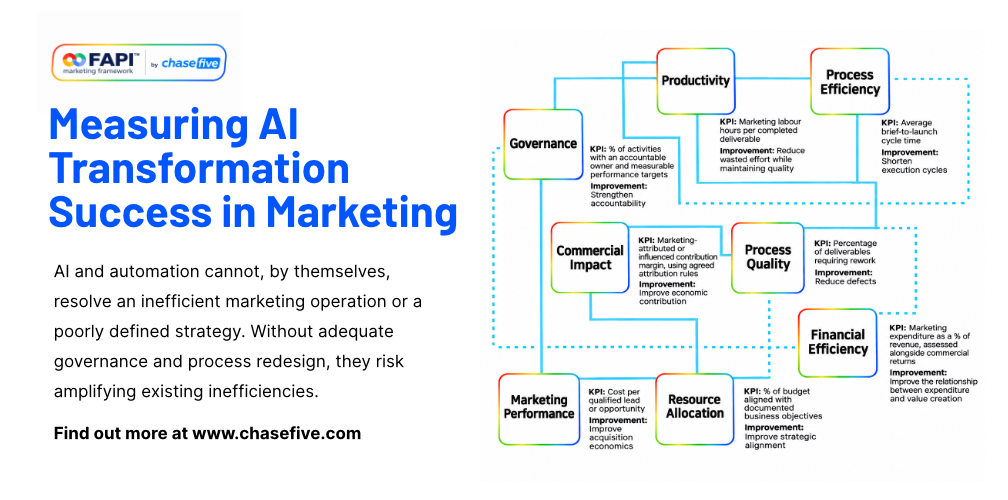
Across modern marketing departments, the rapid adoption of generative AI and automation has created an illusion of progress—faster asset production, higher campaign volume, and lower unit costs—often without a corresponding lift in pipeline or revenue. Achieving marketing excellence in the age of AI requires flipping that sequence: establishing commercial alignment, operational governance, and waste-free workflows before deploying technology at scale. Through the four modules of the FAPI Marketing Framework (Frame, Architecture, Production, and Insights), marketing leaders can move beyond superficial task automation to build a disciplined, measurable function focused on commercial value.
By Chasefive Management • November 4, 2026
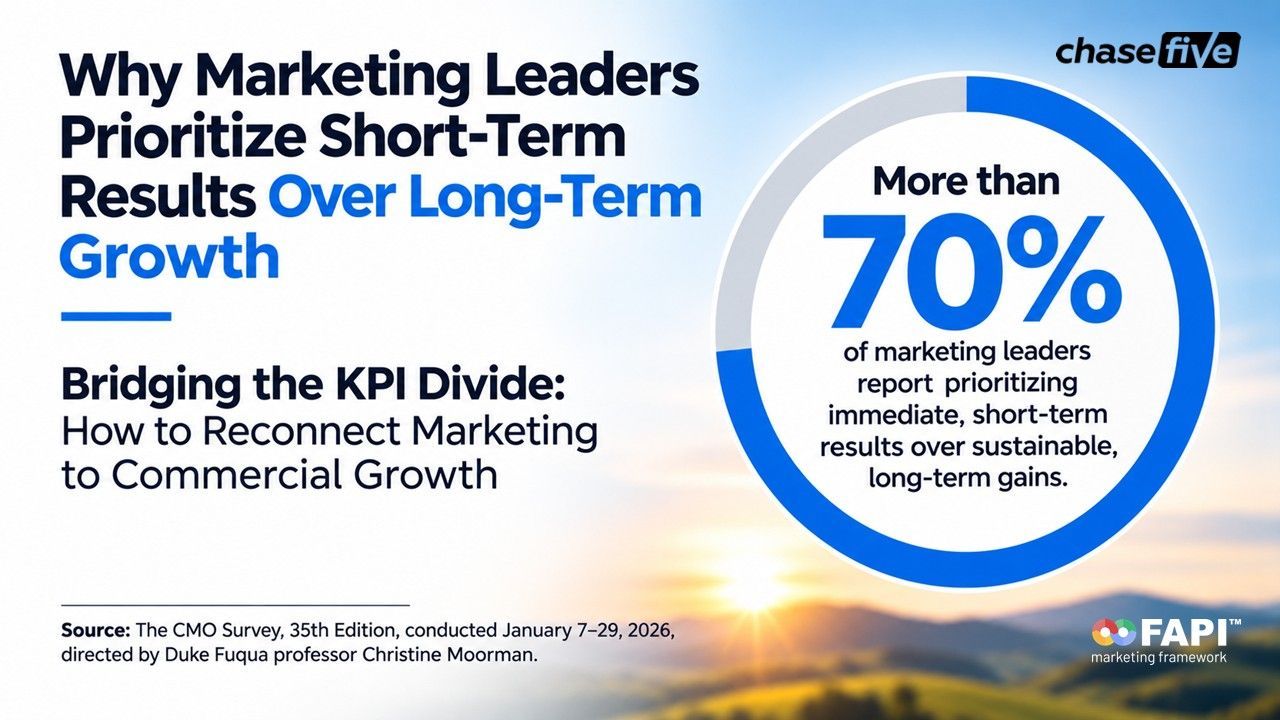
More than 70% of marketing leaders report prioritizing immediate, short-term results over sustainable, long-term gains. According to the 35th edition of The CMO Survey—directed by Duke University Fuqua School of Business Professor Christine Moorman in January 2026—marketing remains entrenched in a cycle of tactical reactivity. Driven by real-time ad platforms and instant feedback loops, marketing teams often find themselves tracking what is easy to measure rather than what creates enterprise value. When operational data points—such as Cost Per Click (CPC), Click-Through Rates (CTR), and email open rates—are served up to executive leadership expecting commercial direction, trust erodes. The result is a widening "KPI Divide" that leaves the C-suite disengaged and marketing relegated to a cost center. Overcoming this tactical bias requires more than just better dashboards; it demands a fundamental shift in how marketing data is structured, interpreted, and governed. The FAPI Marketing Framework resolves this challenge by transforming isolated operational metrics into a commercially aligned decision-making system through five core mechanisms. 1. Bridging the "KPI Divide" with Tiered Reporting Traditional marketing reporting suffers from a single-stream problem: every metric, from granular bounce rates to top-line pipeline figures, gets bundled into one dense, unrefined report. Senior executives are forced to decipher operational noise, while campaign operators lack clear strategic context. The FAPI framework dismantles this dynamic by establishing three distinct reporting layers, each calibrated to a specific organizational role and decision horizon: Commercial Marketing Metrics (C-Suite & Senior Leadership): Evaluated quarterly against the broader business plan. This layer strips away channel noise and focuses exclusively on high-level impact: Return on Marketing Investment (ROMI), Customer Lifetime Value (CLTV), market share expansion, and direct top-line revenue contribution. Marketing-Management Metrics (Plan Masters & Strategists): Reviewed monthly against the tactical Marketing Playbook. This view tracks full-funnel customer progression across five stages: Reach, Validate, Engage, Convert, and Nurture . Marketing-Production Metrics (Campaign & Production Teams): Reviewed weekly during execution sprints. This operational tier monitors day-to-day delivery efficiency—such as ad impressions delivered against planned CPMs, CTRs, and cost-per-acquisition targets—to keep work on schedule and on budget. By separating these streams, production teams retain the operational detail they need to optimize daily workflows, while executive leadership receives clear evidence of commercial performance. 2. Rationalizing Metrics: Delivery, Performance, and Impact A primary reason short-term metrics dominate is that organizations often confuse operational activity with business outcomes. The FAPI framework establishes a strict three-tier hierarchy to ensure tactical efforts are treated as means rather than commercial ends:
By Chasefive Management • October 16, 2026
Artificial intelligence is transforming marketing at an unprecedented pace and it is promises significant gains in productivity, operating efficiency, and organizational capacity. Yet beneath these advances lies an emerging governance challenge. As marketing execution becomes increasingly automated, the relationship between human judgement, decision-making authority, and commercial accountability risks becoming progressively weaker. The central question is no longer simply what AI can do for marketers, but who remains responsible for the decisions, actions, and commercial outcomes that AI increasingly influences. When marketing teams routinely accept algorithmic recommendations without questioning their rationale, professional judgement gradually gives way to passive system monitoring. Decisions that previously required deliberate human evaluation become embedded in automated workflows, making it increasingly difficult to delineate responsibilities across planning, production, quality control, and ultimate commercial outcomes. While AI expands an organisation's capacity to act, it can simultaneously erode the human agency necessary to exercise meaningful control over those actions. Addressing this challenge requires more than technical safeguards, compliance policies, or additional management oversight. It demands a more sophisticated approach to marketing governance, one that establishes clear strategic direction, defines decision-making authority, aligns operational resources, and preserves accountability throughout the marketing function. The interplay of marketing governance, agency, and accountability Effective marketing governance begins with recognising that governance, agency, and accountability are distinct yet interdependent organizational principles. Governance establishes how the marketing function is directed, controlled, and overseen. It defines the strategic boundaries, operating standards, ethical principles, responsibilities, and decision-making structures within which marketing activities occur. Agency provides individuals and teams with the authority, autonomy, resources, and capacity to make decisions and act on behalf of the organisation. It serves as the mechanism through which governance becomes operational, enabling professionals to exercise judgement and take meaningful action within defined boundaries. Accountability ensures that those individuals and teams remain answerable for their decisions, actions, and performance. It requires clearly assigned responsibilities, transparent reporting, effective oversight, and robust mechanisms for evaluating outcomes and implementing corrective action.
By Chasefive Management • September 11, 2026
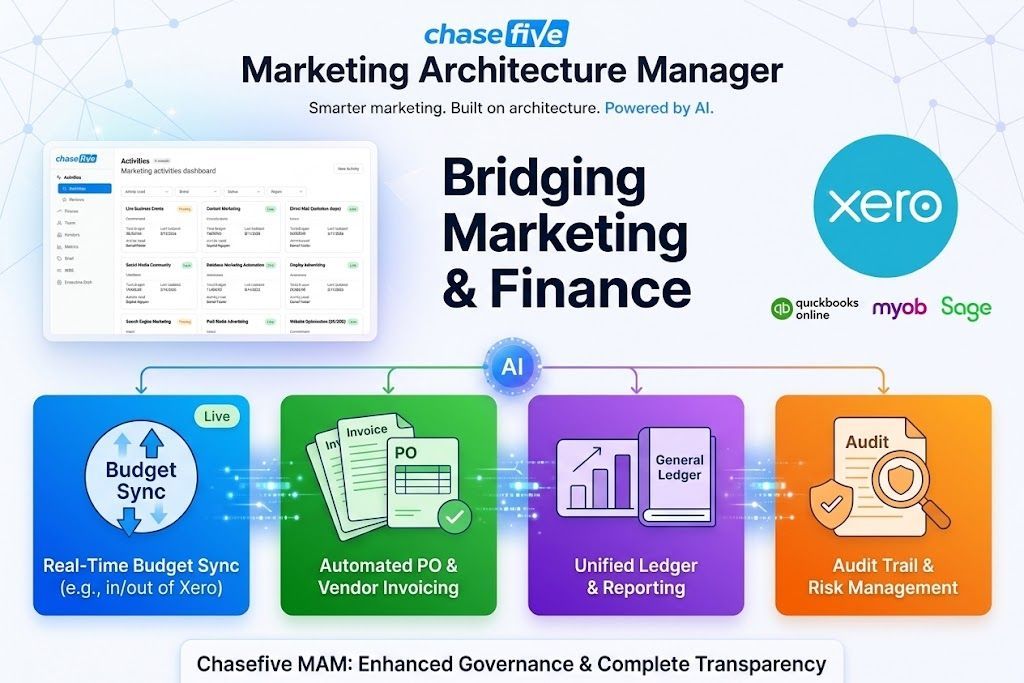
Bridging Marketing and Finance: Chasefive MAM Now Integrates Direct with Accounting Software including Xero If you have ever had to reconcile a marketing campaign budget against actual bank line items at the end of a quarter, you know the pain. Spreadsheets drift out of sync, purchase orders go missing, and finance teams end up chasing marketing managers for invoices that were due weeks ago. To fix this gap between campaign execution and financial control, we’re excited to announce that the Chasefive Marketing Account Manager (MAM) app now natively integrates with Xero and all major accounting software suites. Why Marketing Governance Needs Accounting Integration Marketing teams move fast, but corporate governance demands strict financial accuracy. When marketing workflows run separately from your core ledger, two major issues happen: Delayed Visibility: Executive teams don't see true spend until weeks after a campaign launches. Compliance Risks: Unapproved vendor expenses and untracked purchase orders slip through the cracks, creating headache-inducing audit trails. By connecting Chasefive MAM directly to your accounting ecosystem, you create a single source of truth for every dollar spent. What’s New in Chasefive MAM? Real-Time Budget Sync Track committed expenditure alongside actual spend in real time. The moment an invoice or PO is created in your accounting tools—including Xero, QuickBooks, MYOB, and Sage—it is reflected in Chasefive MAM. Automated Vendor & Invoice Workflows Say goodbye to manual double-data entry. Sync vendor details, invoice approvals, and campaign line items automatically, saving hours of monthly administrative work for both marketing and finance teams. Built-In Audit Trails Ensure full governance and compliance without slowing down creative execution. Standardized approval workflows give finance leaders complete transparency while keeping campaign managers moving. Smarter Governance for Modern Marketing Teams Effective marketing isn't just about launching bold campaigns—it's about proving ROI with rock-solid data. With native accounting integration, Chasefive MAM gives CMOs and Finance Directors the confidence that every strategy is fully compliant, accurately budgeted, and optimized for performance. Ready to streamline your marketing operations and financial tracking? Explore the updated platform features and see how Chasefive MAM can support your team at chasefive.com/marketing-manager.
By Chasefive Management • August 17, 2026
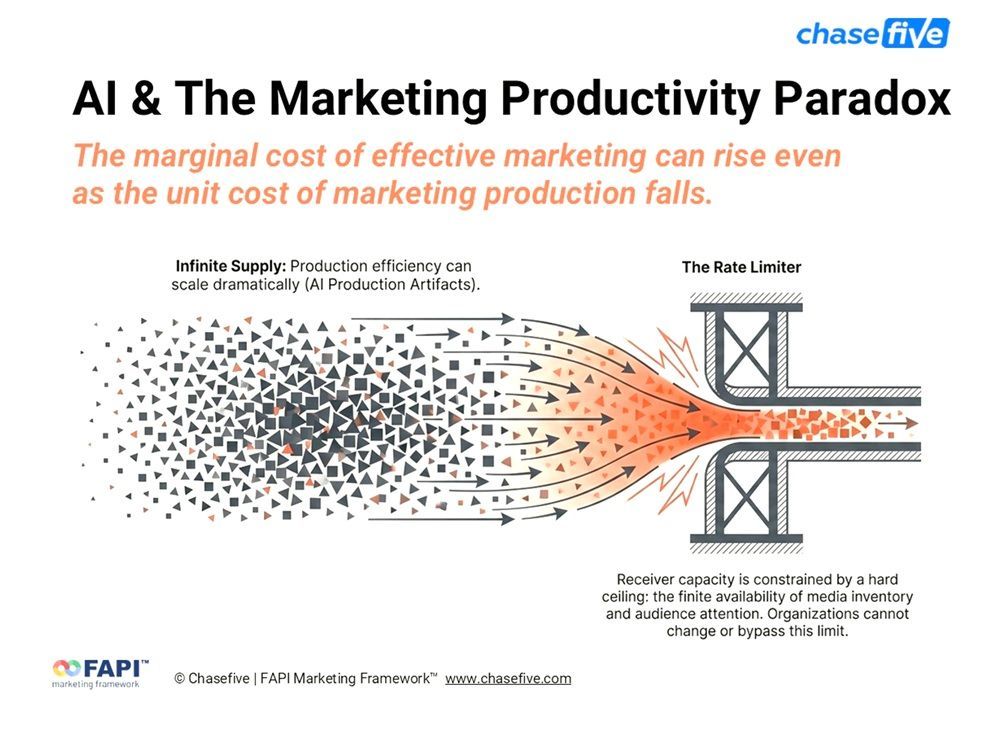
AI capabilities have already had a significant impact on marketing, and that impact will continue to accelerate. The prevailing view among business leaders is that AI is likely to help reduce the cost of marketing, an expectation shared by many marketing practitioners. But this assumption deserves closer examination. Understanding how AI may ultimately affect marketing expenditure requires a more holistic view of the underlying economics of marketing execution. Predicting whether AI will drive an increase or decrease in marketing expenditure should begin with an analysis of how marketing cost dynamics are structured. The fundamental cost structure of marketing execution The overall cost of marketing execution is determined by two primary drivers: P) Cost of Production : The cost of producing the artifacts that construct and communicate a marketing message. M) Cost of Media : The cost of carrying that marketing message to its intended audience. The total cost of production (P) can be divided into two broad categories: labor costs (skills and human resources) and tool costs (technology and materials). The cost of media, or visibility (M), encompasses media in all its various forms, online and offline, from advertising, sponsorship, endorsements, pay-to-publish and any other forms of amplification. For the purposes of this analysis, we can include “organic” (or earned) media in the cost of media. While organic media is not paid in the usual sense, its availability and reach is impacted by the direct or indirect provisioning of paid media, as discussed in the article on the scarcity and volatility of organic media . The impact of decreasing marketing production costs and its compounding effects The cost of a unit of marketing production has been gradually but consistently declining for some time, driven predominantly by three trends. First, the widespread offshoring of certain marketing production services to lower-cost economies is reducing labor costs. Second, the introduction of software applications has reduced marketing’s reliance on expensive, IT-heavy production. Third, the significant expansion of training and development opportunities for people entering the marketing production workforce has created a healthy skills supply and, therefore, competition among qualified marketing production specialists across a wide range of disciplines. However, hard evidence shows that greater production efficiency over a prolonged period has not automatically translated into lower overall marketing expenditure for businesses. This exposes a fundamental misconception in marketing economics: reducing the unit cost of production does not necessarily reduce the total cost of marketing but instead increases production complexity. An example of this dynamic is the rising cost of the martech stack, the technologies and tools used to support marketing production and execution. Martech was originally positioned as a cost-containment strategy, enabling organizations to replace expensive, bespoke IT systems with more flexible and economical SaaS solutions. In the immediate term, martech tools increased the productivity of marketing teams and helped reduce the unit cost of production. Over time, however, this contributed to increased competitiveness and the need for complex architecture solutions. As a result the economics of martech shifted and marketing software tools now account for an estimated 25–30% of marketing budgets, compared with less than 10% less than fifteen years ago. The number of available solutions grew from roughly 150 in the early 2010s to more than 12,000 by 2025, pushing marketing teams to adopt increasingly complex technology stacks and forcing organizations to reassess how martech is evaluated and implemented. The AI cost causal loop: Marketing efficiency rate-limiter and primary upward cost drivers At its most fundamental level, increasing marketing productivity means increasing the rate at which organizations can produce marketing artifacts. That sounds inherently beneficial. However, the ability of those artifacts to achieve cut-through is constrained by a hard rate limiter: the finite availability of media inventory and audience attention . An organization’s marketing production efficiency may increase dramatically, but its receiver capacity has a hard ceiling that it cannot change or bypass. This ceiling is determined by the availability and accessibility of media inventory and ultimately by the audience’s available share of attention and interest. A steep increase in marketing production output is likely to determine a saturation of media inventory and relative price increase, and at the same time a decline in the addressable audience's rate of response. Because in today's performance-driven media buying ecosystem, the price of media exposure is ultimately determined by the propensity of an addressable audience to respond to or engage with a message, as the share of interest declines, the effective availability of media inventory also declines. As effective media reach becomes more expensive—either because unit costs increase or because a higher frequency of exposure is required to generate the desired level of response—organizations will need greater reach, higher frequency, broader distribution or more sophisticated targeting to achieve the same level of impact. This creates a reinforcing causal loop.
Show More